
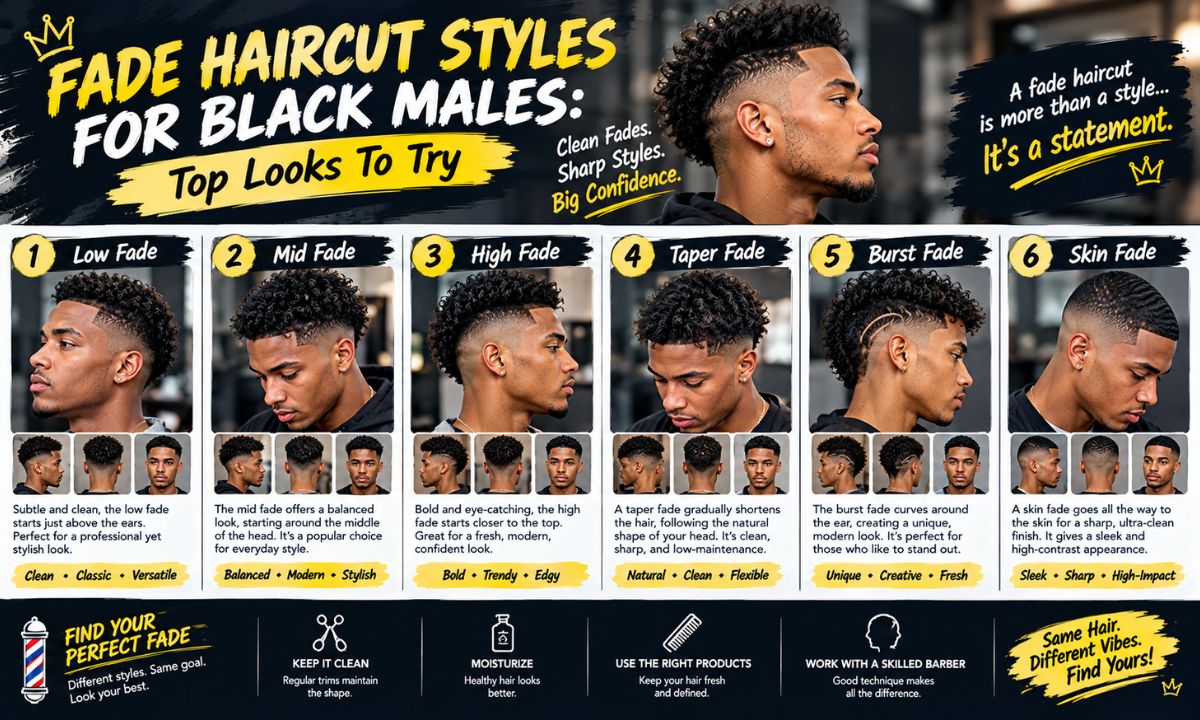
A clean fade can change how you look in one barber visit. The sharp lines, the smooth blend and the crisp shape-up all say one thing: you take care of yourself.
On black men’s hair, the fade works especially well. Coily and curly textures hold shape, so the contrast between short sides and a fuller top looks bold and clean.
This guide covers what a fade is, the main types, 45 style ideas, and how to match a fade to your hair type and face shape. You will also get barber-ready phrases, a care routine and quick FAQs.
What Is a Fade Haircut?
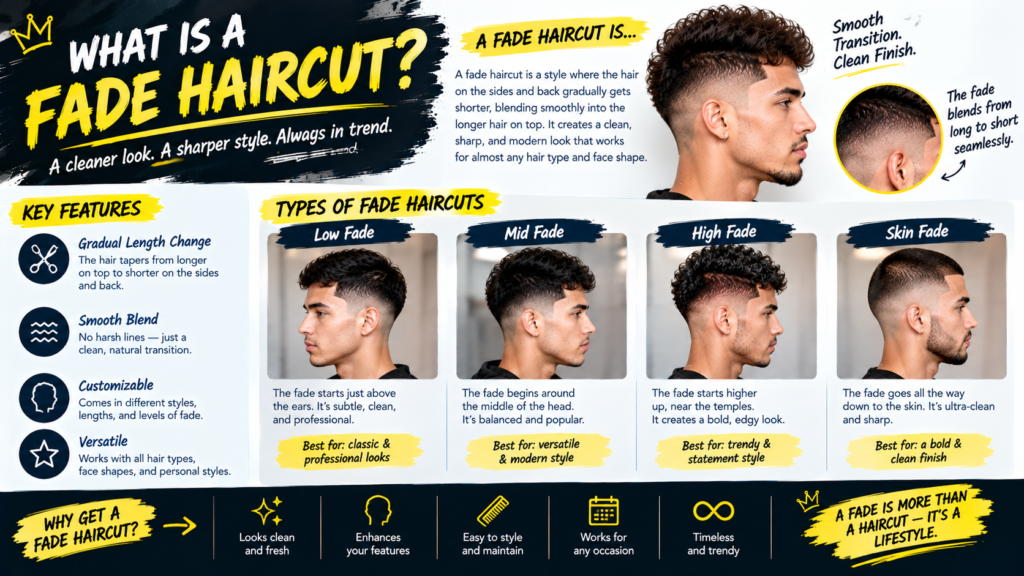
A fade is a cut where hair gets gradually shorter down the sides and back of the head. It starts longer near the top and blends into very short hair, or bare skin, near the neckline and ears.
The key word is gradual. There is no hard step between lengths. The barber uses clippers, guards and blending technique so the hair seems to melt from one length to the next.
A fade is a technique, not one fixed haircut. You can pair it with a buzz cut, waves, twists, a high top, an afro or a beard. That flexibility is why it fits almost every style.
What Does a Fade Haircut Mean?
When people say “fade,” they mean the blended gradient on the sides and back, where hair seems to fade away into the skin. In barbershop language, the word also describes the whole cut. “I got a fresh fade” usually means sharp edges, clean blending and a neat line-up.
Why Fades Are Popular Among Black Men
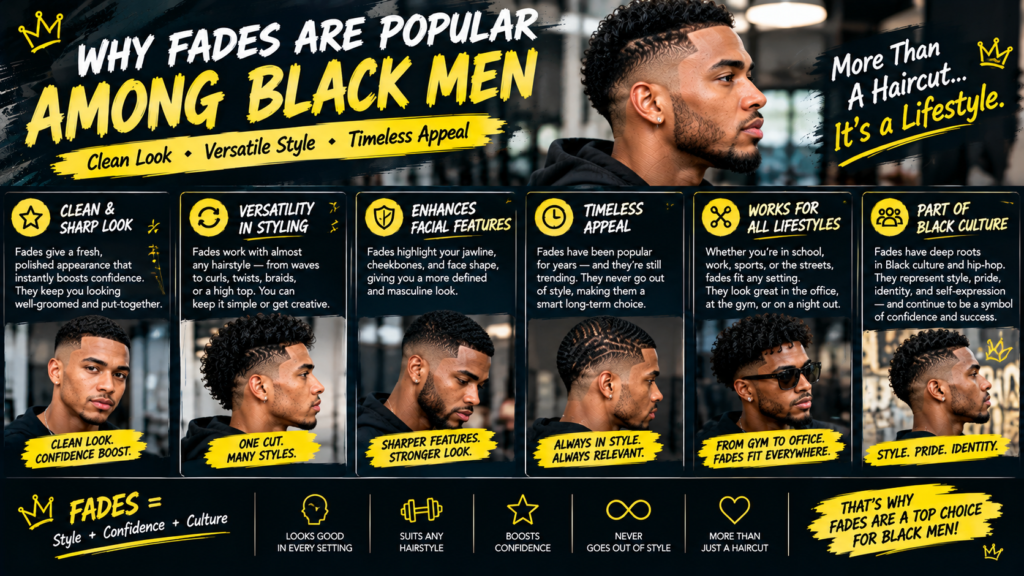
Fades have deep roots in black barbershop culture. For decades the barbershop has been a place for community, conversation and craft, and skilled barbers turned the fade into an art form. The style stays on top for good reasons:
- It suits a coily and curly texture. Tight curls hold a defined shape, so the blend looks crisp.
- It is versatile. You can go low-key or bold with the same technique.
- It looks sharp and fast. A fresh cut with a line-up reads as polished at work, at events or on the street.
- It is easy to style. Short sides mean less daily effort.
- It shows personality. Designs, parts, colour and waves make the cut a signature look.
- It keeps you cool. Shorter sides help in hot weather.
Social media and sports culture keep fades in the spotlight, with athletes, artists and everyday trendsetters inventing new versions.
Fade vs Taper Fade
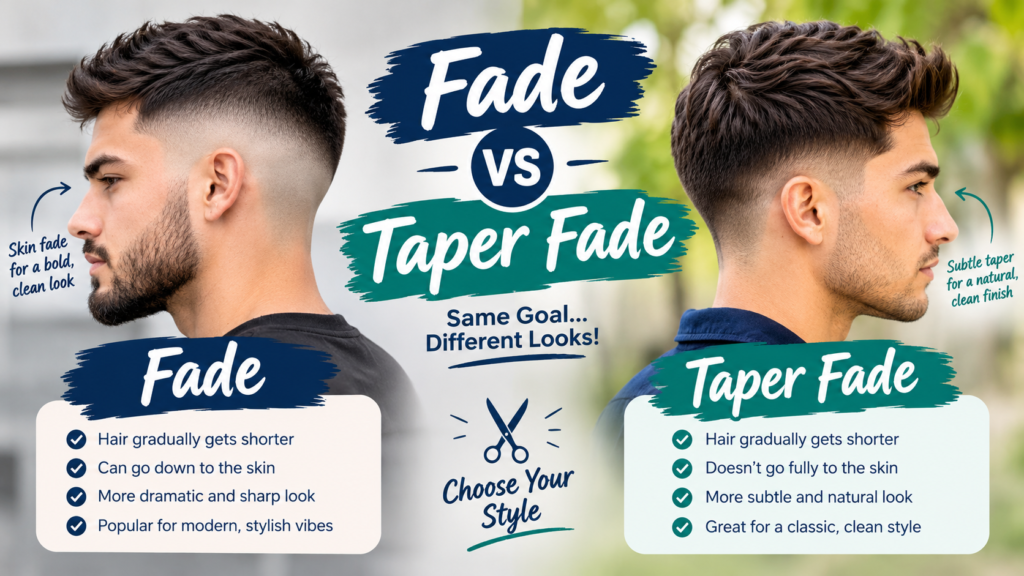
The difference is how much hair is removed and how dramatic the blend looks. A fade goes much shorter, often to the skin, and covers more of the sides and back. A taper fade only trims around the neckline and sideburns, leaving more length elsewhere.
| Feature | Fade | Taper Fade |
| Blend area | Larger part of sides and back | Neckline and sideburns only |
| Shortest length | Often skin (0) | Usually a short guard, rarely skin |
| Look | Bold, high contrast | Soft, classic, professional |
| Maintenance | Every 1–2 weeks | Every 2–4 weeks |
| Best for | Statement styles | Office-friendly, low-key looks |
Want a safe start? Try a taper. Want contrast and edge? Go for a full fade. Many men start with a taper and move to a fade once they feel confident.
Types of Fade Haircuts
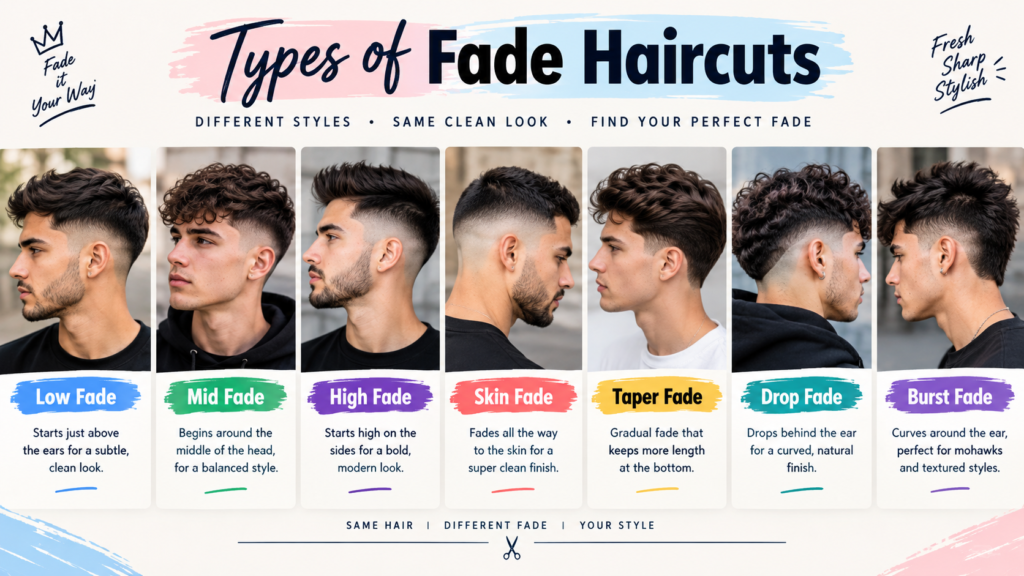
Each fade type changes where the blend begins and how much hair stays on the sides.
Low fade: Starts just above the ears and follows the natural hairline around the back. It leaves more hair on the sides, so it looks soft and clean. A great first fade and a safe choice for work.
Mid fade: Begins about halfway up the sides, near the temples. It sits between low and high, so it feels balanced. This is the go-to for many barbers because it adds shape and leaves enough hair for styling.
High fade: Start high on the head, near the temples or above. The sides get very short, so the top stands out. Bold and modern, it pairs well with high tops, curls, twists and afros.
Skin fades: Blends all the way to bare skin, often finished with a foil shaver. It can be low, mid or high. It gives the sharpest contrast but needs regular touch-ups.
Drop fade: The line curves down behind the ear instead of running straight around the head. This frames the head with a clean, modern outline.
Burst fades: Fades around the ear in a semicircle and leaves longer hair at the back. Popular with mohawks, faux hawks and curls, and a strong choice if you want to keep length behind.
The temple faded: Often called a temp fade, it focuses on the temples and nape with a tight, precise blend. It gives a razor-sharp frame to the hairline and pairs well with beards and line-ups.
The tape faded: Gradually trimmed the sideburns and neckline. Subtle, professional and easier to maintain than a skin fade.
Bald fade. Also called a zero fade, it blends into completely smooth skin. It is the most dramatic version, making the top look thicker and the lines cleaner. Expect frequent barber visits.
Quick Comparison
| Fade Type | Starts At | Contrast | Maintenance | Best For |
| Low fade | Above ears | Low | Medium | Work, first-timers |
| Mid fade | Temples | Medium | Medium | Everyday, versatile |
| High fade | High on head | High | High | Bold, modern looks |
| Skin fade | Any height | Very high | High | Sharp, clean finish |
| Drop fade | Behind ear curve | Medium | Medium | Curved outline |
| Burst fade | Around ear | Medium–high | Medium | Mohawks, curls |
| Temple fade | Temples and nape | Medium | Medium | Beards, line-ups |
| Taper fade | Neckline, sideburns | Low | Low | Professional style |
| Bald fade | Skin level | Very high | Very high | Statement cuts |
45 Best Fade Haircut Styles for Black Males
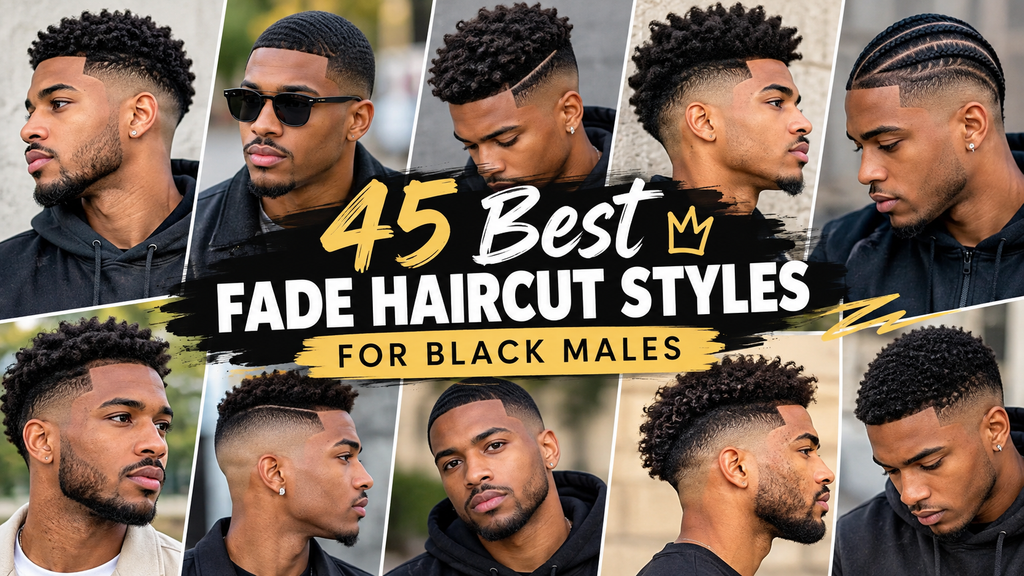
Use these as inspiration, then show your barber a photo so you both see the same thing.
- Clean Line Up Fade with Beard. A crisp forehead line-up and a tidy beard make a polished pair. The fade blends into the beard for a connected look.
- Curly High Fade: Soft curls on top over a high fade give volume and sharp contrast. Keep curls moisturised for definition.
- Wavy Skin Fade: Brushed waves on top meet a skin fade on the sides. Sleek and disciplined.
- Bald Fade with a Shaved Side Part: A razor-cut part adds a small detail that stands out. Simple but striking.
- Shape Up Low Fade: A low fade with a sharp shape-up around forehead and temples. Clean, low-risk and ideal for the office.
- Burst Fade Faux Hawk: Short sides, a burst around the ears and a centre ridge on top. Bold without a full mohawk.
- Wavy Low Fade: Waves brushed forward or sideways over a low fade. Relaxed and classic.
- High Skin Fade with 360 Waves: A high skin fade under deep, rolling waves. It needs time and a good brush, but the result is sharp.
- Temple Fade with Sponge Twists: Sponge twists add texture while the temple fade keeps the frame neat. Great for short natural hair.
- Curly Top Skin Fade: Loose curls over a clean skin fade. The contrast makes curls look fuller.
- High Top Fade: Hair lifted straight up with a flat or rounded top. A retro look that still feels current.
- Zero Fade Buzz Cut: A buzz with a zero fade keeps the whole head short and even. Fast and tidy.
- Textured Crop Fade: A short, messy top over faded sides. Modern and relaxed; add styling cream for texture.
- Short Afro Bald Fade: A compact afro over a bald fade. The skin blend makes the afro look rounder.
- Taper Fade Faux Hawk: A gentle taper with a faux hawk. Classic cut, playful shape.
- Afro Mohawk Fade: A wide, fluffy mohawk with faded sides. A big statement for men who love volume.
- Burst Fade Mohawk: The mohawk runs down the centre and curves around the ears with a burst. Dramatic and modern.
- Low Taper Fade: A soft low taper frames ears and neckline. Safe and tidy for any setting.
- Curly Burst Fade: Curls on top and a burst around the ears add shape and movement. Keep length at the back for balance.
- Kinky High Fade: Tightly coiled hair over a high fade for a crisp, structured look. Light shaping keeps the top neat.
- Mohawk Fade: A classic mohawk with clean fades on both sides. Skin fade for drama, low fade for a softer finish.
- Flat Top Fade: A squared top over a sharp fade. A bold throwback that needs a skilled barber.
- Pomp Fade. Hair swept up and back into a smooth pompadour, with tight, neat sides.
- Dreadlock Fade: Locs on top with a faded back and sides. Tidy, easy to manage, finished with a fresh line-up.
- Skin Fade with Beard: The skin fade melts into a full beard. Keep the beard shaped and the cheek line sharp.
- Fade with Hair Design: A thin razor design such as lines, a lightning bolt or a small shape adds personality. Keep it simple.
- Bleached Fade: Bleached tips contrast strongly with dark sides. Deep condition, because bleach dries textured hair.
- Waves Fade: Brushed waves over a tight fade. A wave cap at night and regular brushing keep the pattern deep.
- Twists Fade: Short twists on top, fade on the sides. Neat and textured, and great for men growing their hair.
- Cornrows with Fade: Braids straight back or in a pattern with faded sides. Protective and stylish.
- Sponge Curls Fade: Sponge curls make tight, defined coils. Pair with a mid or low fade for balance.
- Buzz Cut Fade: A short, even buzz with a fade on the sides. Minimal and very low effort.
- Drop Fade with Beard: The curved drop follows the jawline and meets the beard, making the face look sharp.
- Afro Fade: A rounded afro with faded sides and back. The contrast gives the afro a clean outline.
- Box Fade: A squared top with a square outline around the back. Bold and geometric.
- Curly Taper Fade: Soft curls and a gentle taper. Polished and easy to wear.
- Temple Taper Fade: A tight taper around temples and neck for a clean frame. Suits office and formal settings.
- Mid Fade with Beard: A balanced mid fade blended into the beard. Trim the beard lines for a neat finish.
- Low Fade with Line Up: A low fade with a sharp forehead line-up. A classic barbershop favourite.
- High Fade with Hard Part: A high fade with a razor-cut hard part on the side for a sharp, defined look.
- Fade with Razor Line: A fine razor line separates the fade from the top for an extra-crisp edge.
- Short Fade Haircut: Short on top and sides with a smooth blend. Ideal if you want almost no daily styling.
- Thick Curly Fade: Full curls over a clean fade. The volume looks even bigger against tight sides.
- Natural Afro Fade: Let your natural texture grow on top and keep the sides faded. Healthy and low-styling.
- Modern Skin Fade: A contemporary skin fade with a textured or sharply cut top. Add a line-up to complete it.
Best Fade Haircuts by Hair Type
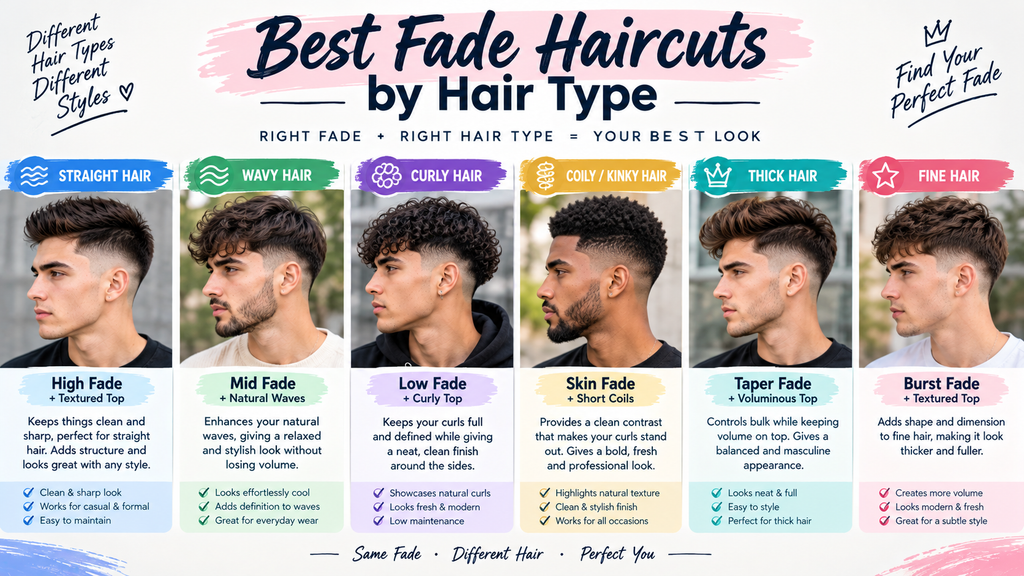
Your texture changes how a fade looks and behaves.
- Curly hair: Mid or high fade with loose curls on top. Moisturise daily so curls stay soft and defined.
- Coily hair: Holds shape well. A skin, temple or taper fade shows off the tight coil pattern.
- Afro hair: A low, mid or drop fade looks neat and bold. Keep the afro rounded and balanced.
- 360 waves: Waves need short hair, a fade and a brush routine. A low or mid fade frames the pattern best.
- Twists: Short twists work with burst, temple and taper fades and need little styling.
- Dreadlocks: A fade on the sides and back keeps the hairline tidy while the locs stay full.
| Hair Type | Best Fade Options | Top Style |
| Curly | Mid, high, burst | Loose curls, sponge curls |
| Coily | Skin, temple, taper | Short coils, twists |
| Afro | Low, drop, mid | Rounded afro |
| 360 Waves | Low, mid | Brushed waves |
| Twists | Burst, temple, taper | Short twists |
| Dreadlocks | Low, mid | Short or medium locs |
Best Fade Haircuts by Face Shape
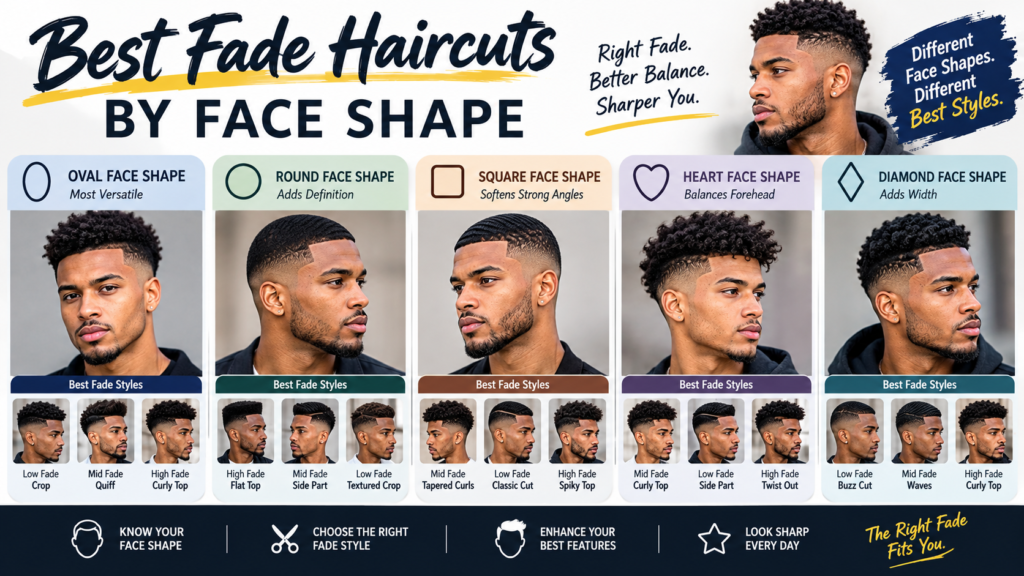
The right fade balances your features.
- Round face: High or mid fade with volume on top. The height makes the face look longer and slimmer.
- Oval face: Suits almost anything. Try low, mid or high fades with any top.
- Square face: Low or mid fade with a rounded top softens strong angles. A skin fade also shows off a firm jaw.
- Long face: Avoid too much height. A low or mid fade with moderate volume keeps balance.
- Diamond face: A low or mid fade with fullness on top balances wide cheekbones. A taper also works well.
| Face Shape | Best Fade | Tip |
| Round | High or mid | Add height on top |
| Oval | Any fade | Experiment freely |
| Square | Low or mid | Soften with a rounded top |
| Long | Low or mid | Keep top volume moderate |
| Diamond | Low, mid or taper | Add fullness on top |
How to Choose the Right Fade
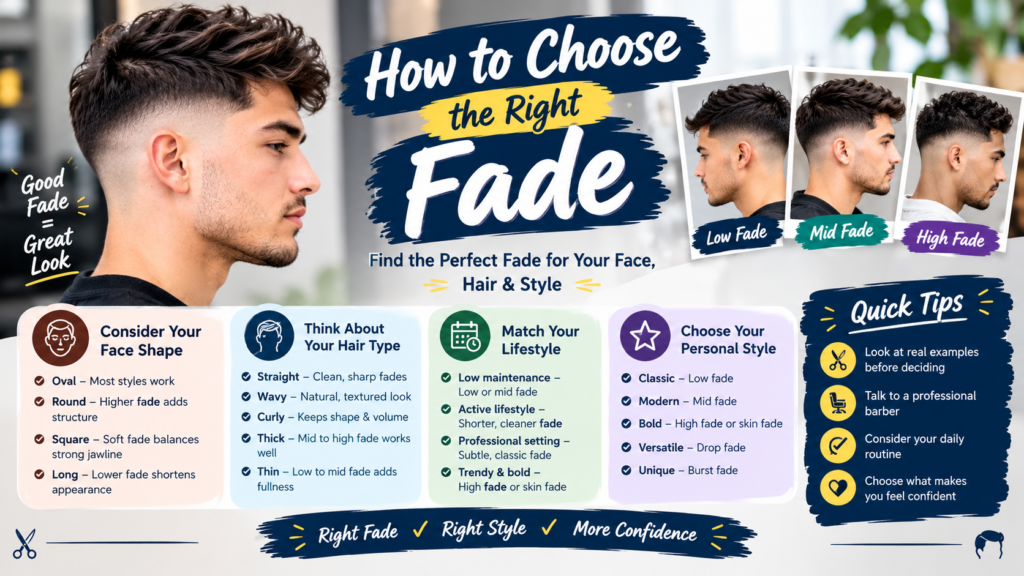
Think about your daily life, not just a photo.
- Hair texture. Tight coils, loose curls and waves react differently to clippers. Ask your barber which fade shows your texture best.
- Lifestyle. A formal workplace suits a low fade or taper. If you want to stand out, go for a high skin fade or a design.
- Beard. Fade and beard should flow together. A skin fade with a short beard looks bold, while a low fade suits fuller beards.
- Maintenance. Skin fades need touch-ups every one to two weeks. Tapers and low fades last longer. Be honest about how often you can visit.
How to Ask Your Barber for a Fade
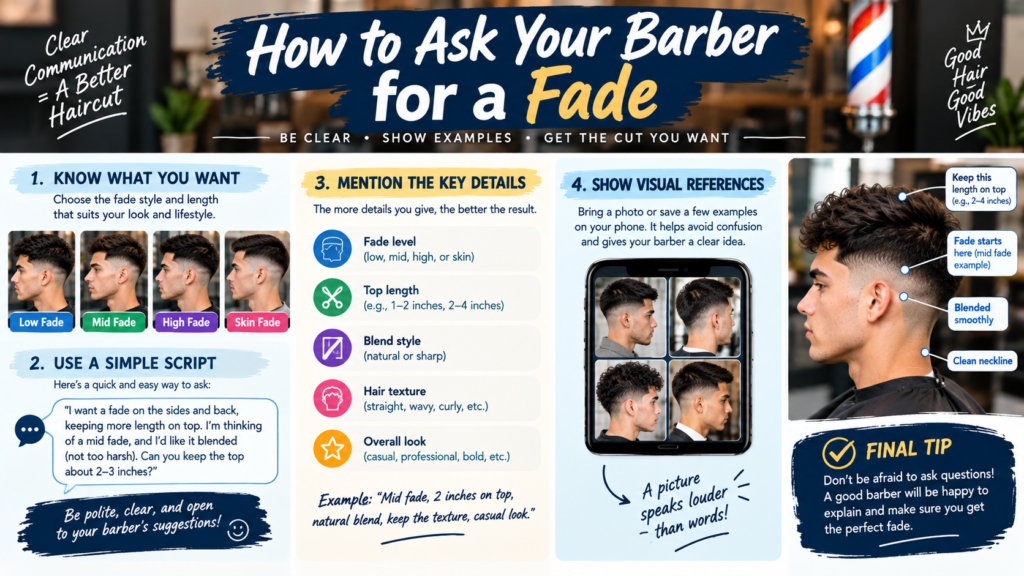
Clear words prevent bad surprises.
- Know the fade height. Say low, mid or high. Mention skin, zero or a guard number if you prefer.
- State the length on top. For example, a quarter inch for waves or two inches for curls.
- Ask for a line-up or shape-up. Say whether you want a natural, soft or sharp hairline.
- Mention your beard. Say if you want the fade blended into it.
- Bring reference photos. Show front, side and back views if you can.
Example phrases:
- “I want a mid skin fade with a sharp line-up.”
- “Please keep two inches on top and blend into my beard.”
- “Can you give me a low taper with a natural hairline?”
Fade Haircut Maintenance Guide
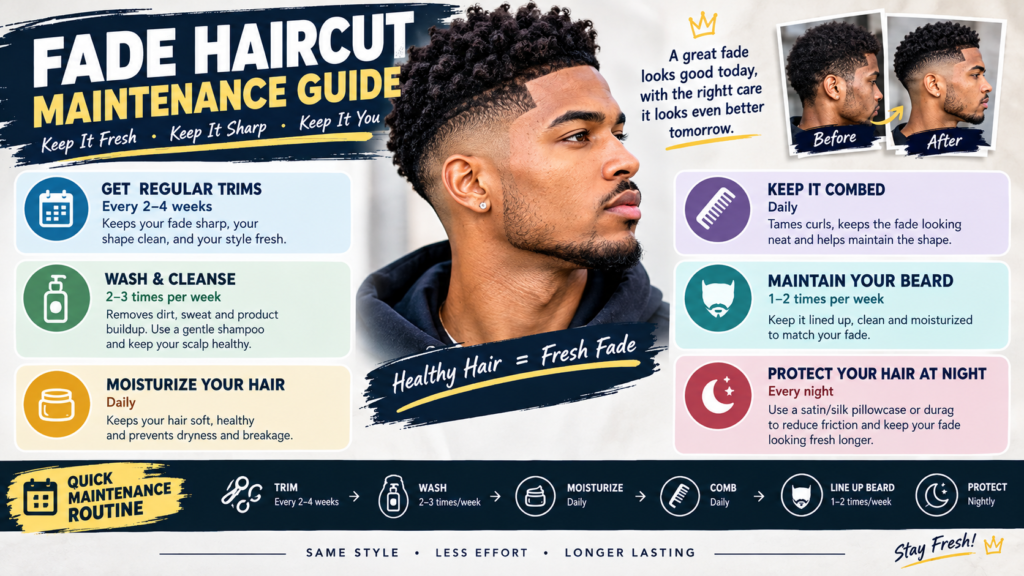
- Visit your barber regularly. Every one to three weeks, depending on the fade. Skin fades lose shape fastest.
- Wash properly. Two or three times a week with a gentle, moisturising shampoo. Over-washing dries coily hair.
- Moisturise daily. Use a leave-in conditioner or light oil on hair and scalp to prevent dryness, flaking and breakage.
- Protect your hair at night. A satin bonnet, durag or wave cap keeps waves in place and cuts friction.
- Brush and style. Brush waves daily. Curl sponges and combs help shape curls and coils.
- Keep the hairline clean. Don’t shave it at home unless you know how. Ask your barber for tips between visits.
Common Mistakes to Avoid
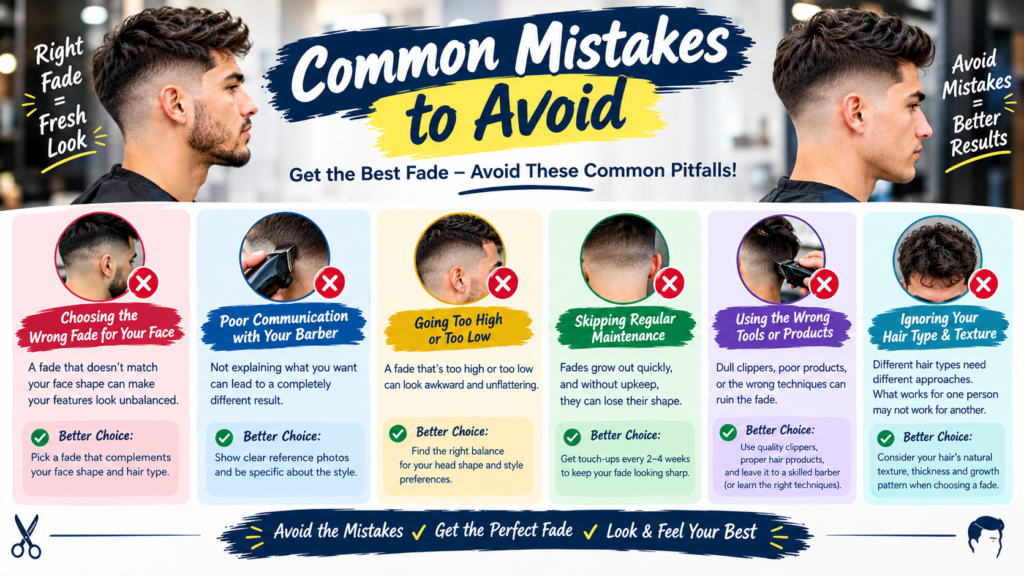
- Wrong fade height. A high fade may not suit a very round face, and a low fade may feel too soft if you want contrast.
- Ignoring texture. A style that works on straight hair may not work on coils.
- Skipping haircuts. Overgrown sides ruin the blend.
- Neglecting hair care. Dry, flaky hair makes any fade look dull.
- Fixing it at home. Home clippers rarely match a barber’s blend.
- Mismatching fade and beard. It looks messy.
A Short History of the Fade
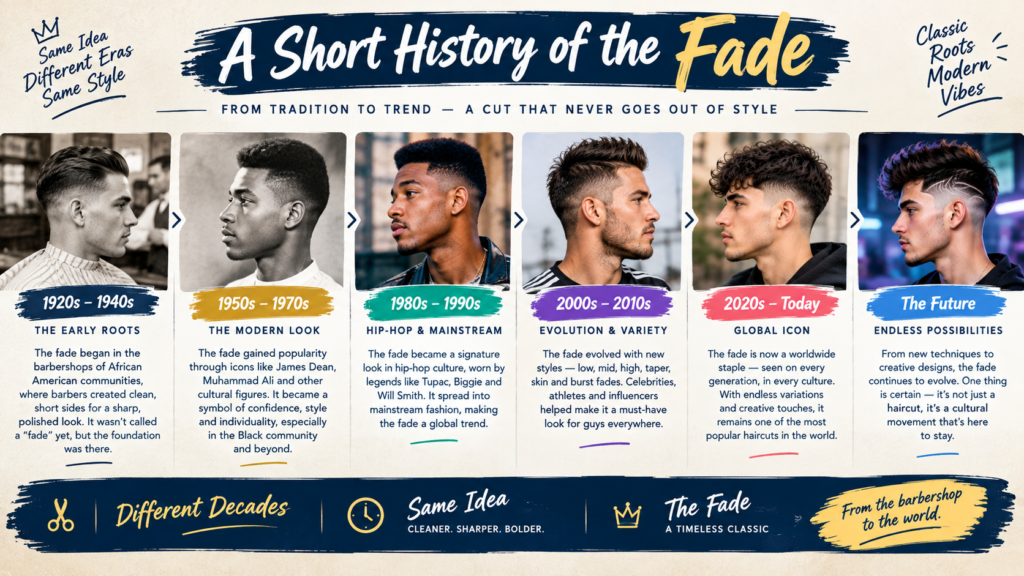
The fade grew out of military-style cuts and barbershop craft. Barbers in black communities took that clipper work and turned it into an art form.
By the 1980s and 1990s, the high top fade and flat top fade were street-style signatures, and hip-hop artists and athletes pushed them into the mainstream. Today’s barbers add razor designs, colour and waves, so the fade keeps evolving.
Best Products for Styling a Fade
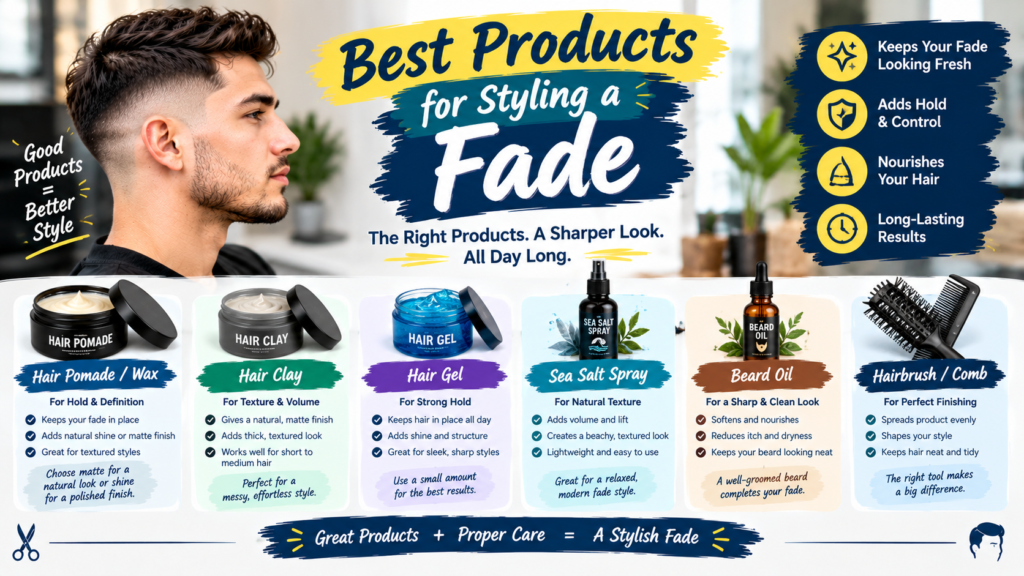
| Product | Best For | Why It Helps |
| Leave-in conditioner | Curls, coils, afros | Adds daily moisture and softness |
| Curl cream | Sponge curls, twists | Defines coils without crunch |
| Pomade or wave grease | 360 waves | Holds the pattern while you brush |
| Light oil (jojoba, argan) | All hair types | Seals in moisture, adds shine |
| Soft boar-bristle brush | Waves | Trains the pattern, spreads oil |
| Edge control | Line-ups and hairlines | Keeps the front neat |
| Satin bonnet or durag | Overnight | Cuts friction, protects waves |
Use small amounts. Too much product weighs hair down and builds up on the scalp.
Best Fade Styles by Occasion
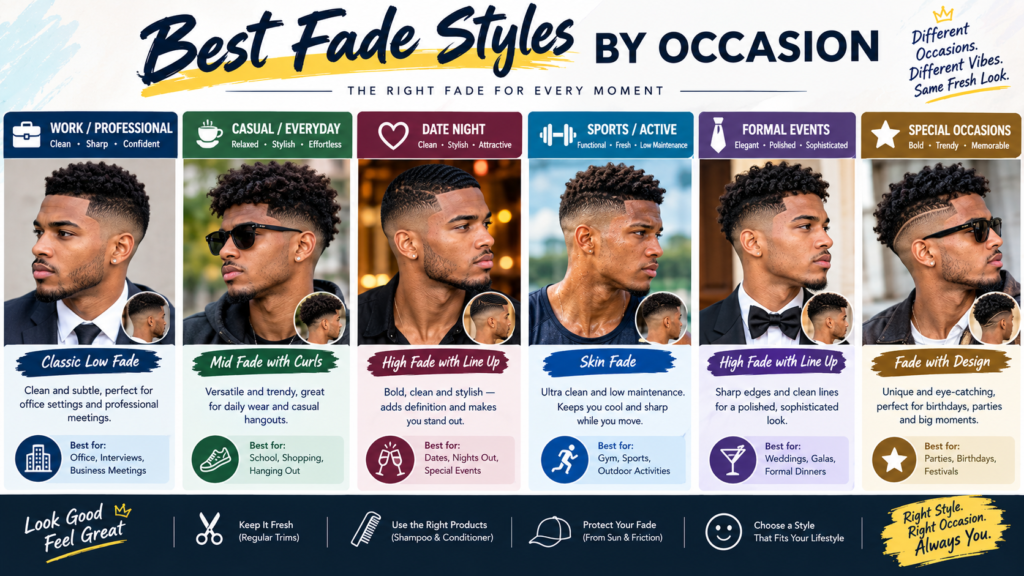
| Occasion | Recommended Fade | Top Length |
| Office and interviews | Low, taper or temple taper | Short |
| Weddings and formal events | Low or mid with clean line-up and neat beard | Short to medium |
| Gym and sports | Buzz cut fade or short fade | Very short |
| Nights out | High skin, burst mohawk or design | Medium to long |
| Everyday casual | Mid fade with curls, waves or textured crop | Any |
Fade Haircuts for Different Ages
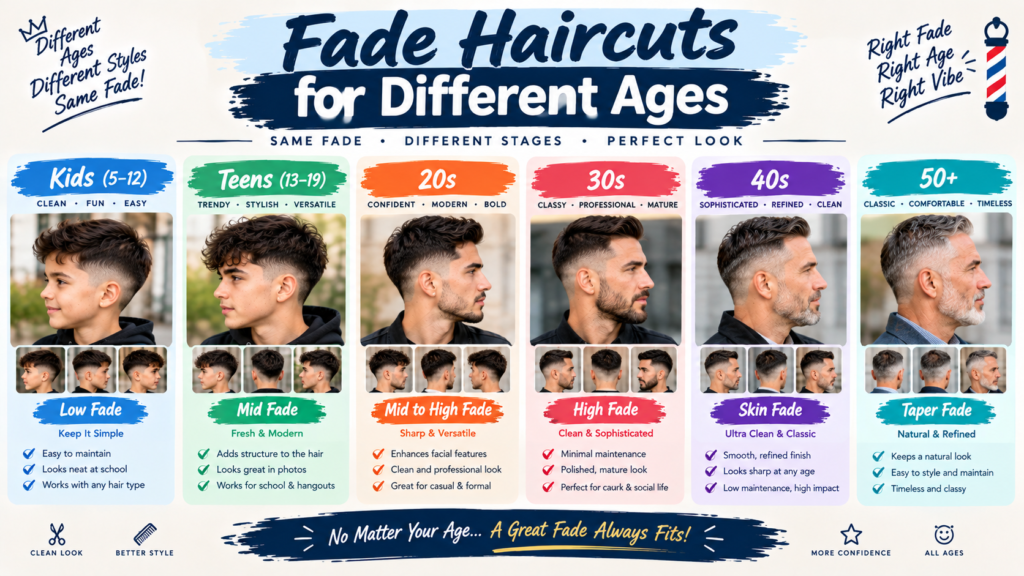
- Teens and young adults. Bolder looks like high tops, bleached tips and designs. Burst and skin fades are common.
- 30s and 40s. A mid or low fade with a neat line-up looks polished in professional settings. A short beard blends in easily.
- Older men. A low taper or short fade with a natural hairline looks sharp, needs little upkeep and keeps thinning areas looking even.
See More: 35 Best Taper Fade Mohawk Haircuts for Men in 2026
How Long Does a Fade Last?
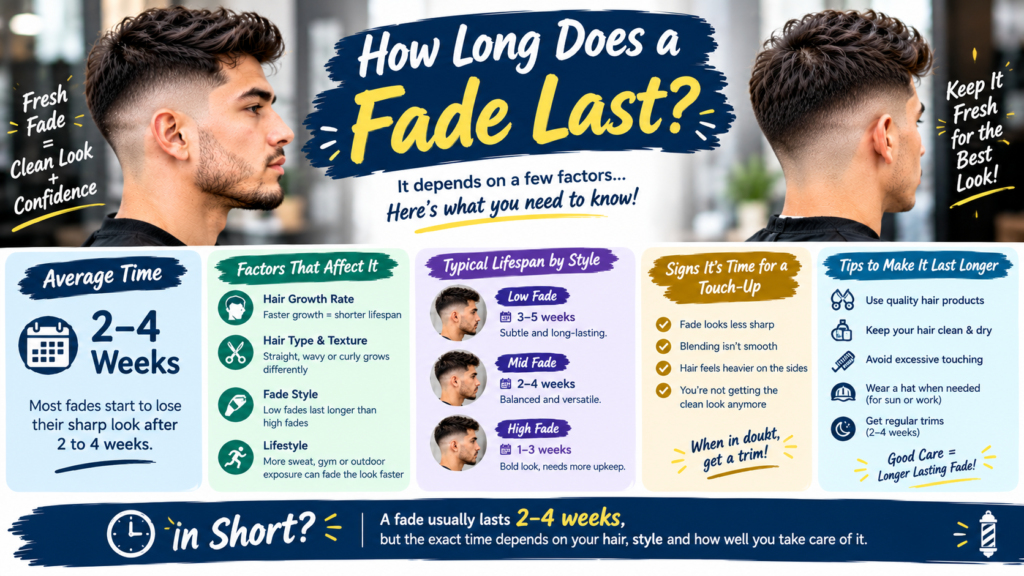
Most fades look best for one to two weeks.
- Week 1: crisp and clean.
- Week 2: edges soften, shape still good.
- Week 3: the blend begins to fill in. A touch-up helps.
- Week 4: mostly grown out.
Low fades and tapers hold shape longer than high skin fades. To save money, ask for a quick line-up between full cuts.
Cost and Barber Tips
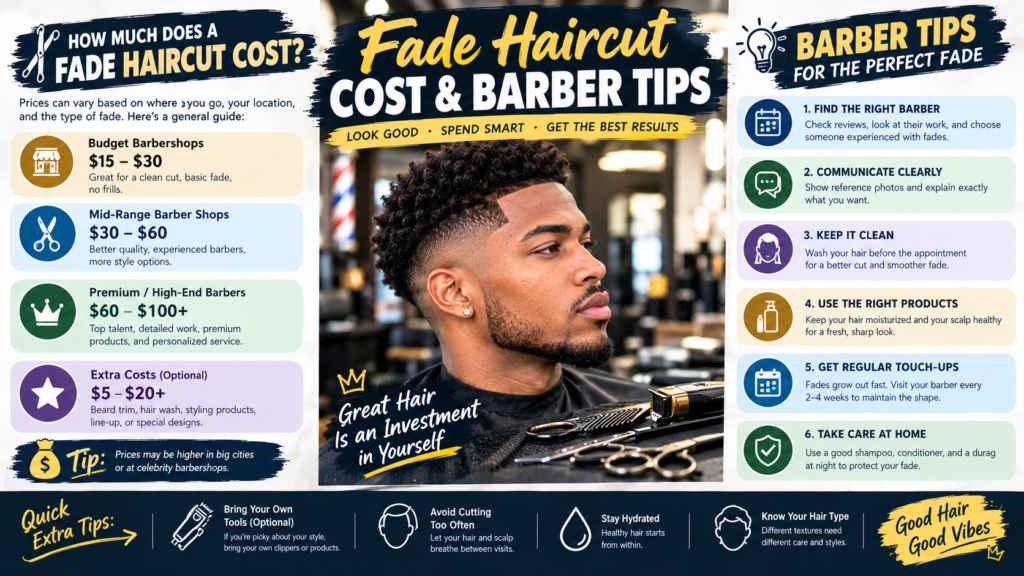
Prices vary by city, barber and style. A basic fade costs less than one with a beard trim, colour or design.
- Book a regular barber so they learn your hair.
- Ask about memberships or packages for weekly line-ups.
- Tip fairly if you are happy with the work.
- Arrive with clean, dry hair so the barber sees your true texture.
- Speak up politely if something feels off before the cut is finished.
How to Grow Out a Fade
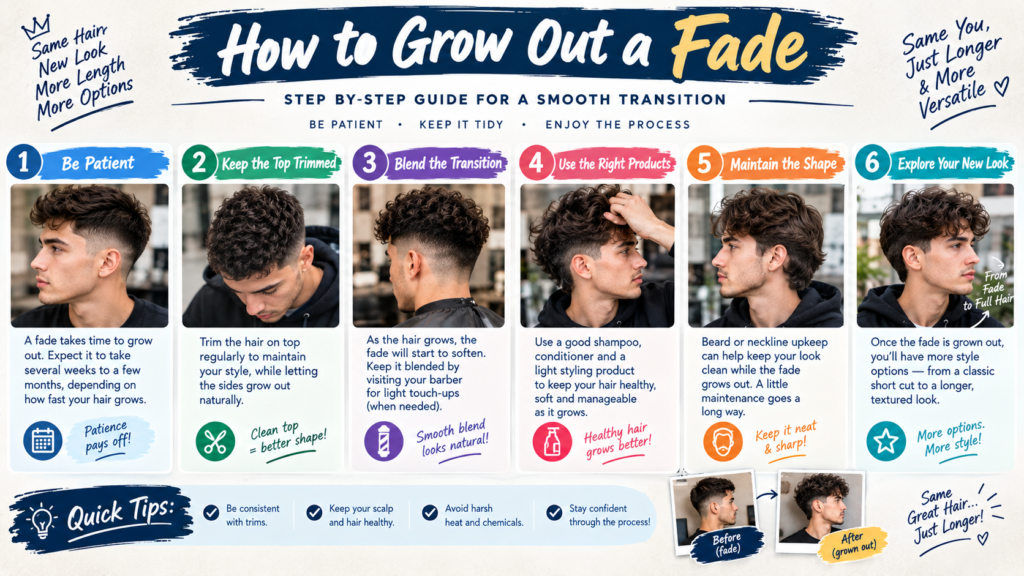
- Start with a taper or low fade so the change feels gradual.
- Keep the sides lightly trimmed to avoid a messy middle stage.
- Ask your barber for shaping every few weeks.
- Use moisturiser and light products to keep growing hair healthy.
- Switch to twists, a high top or a short afro as the top lengthens.
Expect an awkward stage around weeks four to eight. A hat, headband or neat line-up helps.
Barbershop Terms to Know
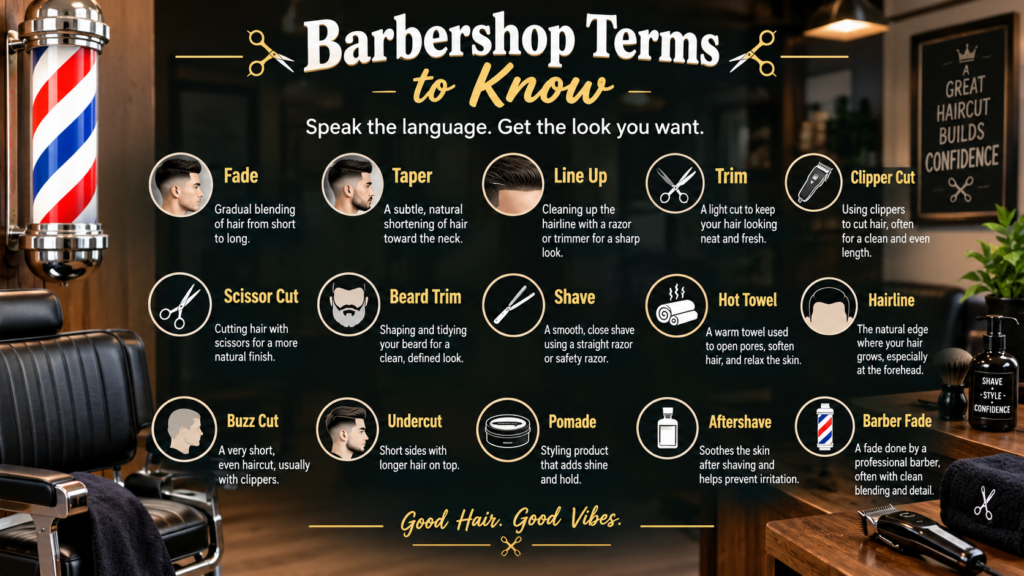
Knowing the language helps you get exactly what you want. These are the words you will hear most.
- Guard number. The plastic comb on the clippers. Lower numbers leave less hair: a 0 or 1 is nearly skin, a 4 or 5 leaves visible length.
- Line-up (shape-up, edge-up). Sharp, straight edges cut along the front hairline, temples and sometimes the beard.
- Blend. The smooth shift between two lengths. A clean blend has no visible lines or steps.
- Foil shaver. A close-cutting electric shaver used for the final skin finish on a skin fade.
- The hard part. A thin line shaved into the hair to mark a part, usually on the side.
- Taper. A shorter, subtler gradient limited to the sideburns and neckline.
- Nape. The back of the neck where the fade ends.
- Natural hairline. A line-up that follows your real hairline instead of squaring or pushing it back.
- Cheek line. Where the beard stops on the cheek. A sharp one makes the beard look deliberate.
How to Find a Good Barber
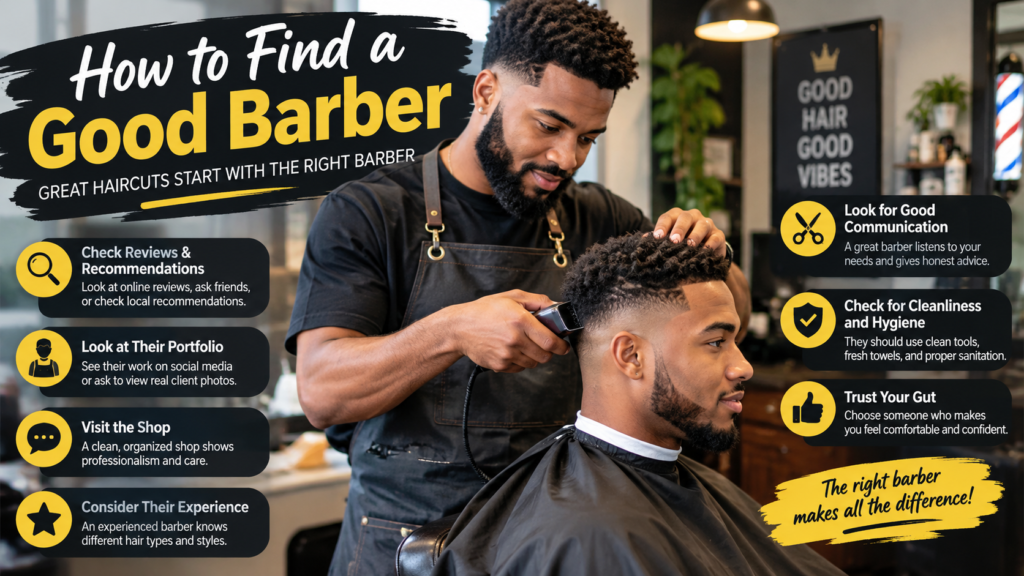
The barber matters as much as the style. A skilled barber blends smoothly, respects your hairline and listens to what you ask for.
- Look at their work. Check recent photos of fades, line-ups and blends on textured hair, from every angle.
- Ask around. Friends, coworkers and people with cuts you admire are the best source of referrals.
- Watch the details. Clean tools, a tidy station and a barber who checks the blend in the mirror are good signs.
- Start small. Try a simple fade or line-up before a complex design.
- Communicate. A good barber asks questions, confirms the length and shows you the result before finishing.
- Stay loyal. Once you find someone good, keep going. Barbers who know your hair deliver more consistent cuts.
Protecting Your Scalp and Skin
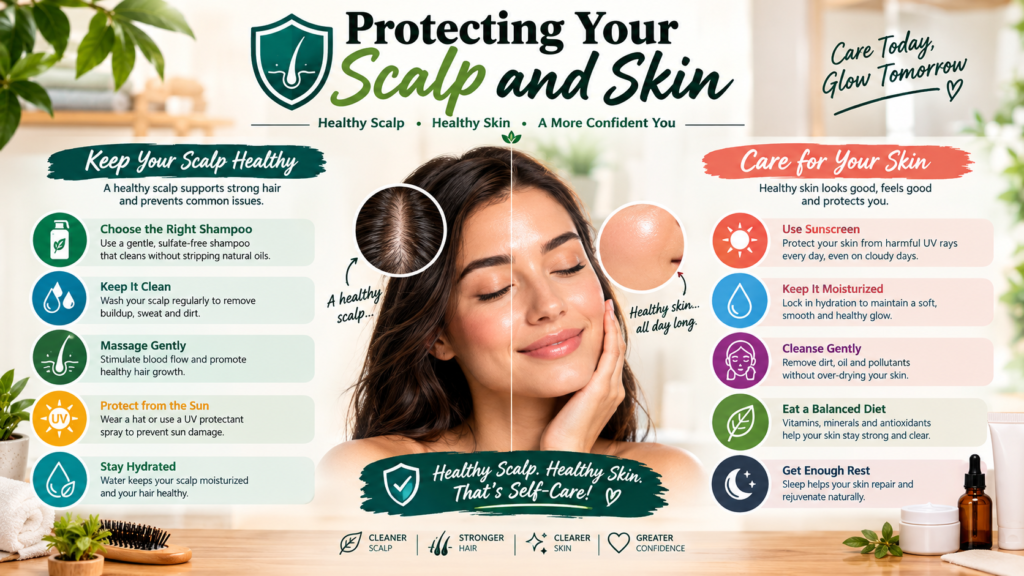
A close fade exposes more skin, so it needs care too.
- Razor bumps. Close shaves can irritate curly and coily hair that grows back into the skin. Ask your barber to cut with the grain, use clean tools and apply a soothing aftershave or balm.
- Dry scalp. Flaking shows more against short sides. Moisturise the scalp and avoid harsh shampoos.
- Sun protection. Freshly cut skin burns easily. Apply sunscreen to exposed areas or wear a hat on bright days.
- Hot water. Very hot showers dry the scalp. Wash with warm water instead.
- Persistent irritation. If bumps, itching or patches do not settle, see a doctor or dermatologist rather than guessing at home.
Which Fade Should You Pick? A Quick Guide
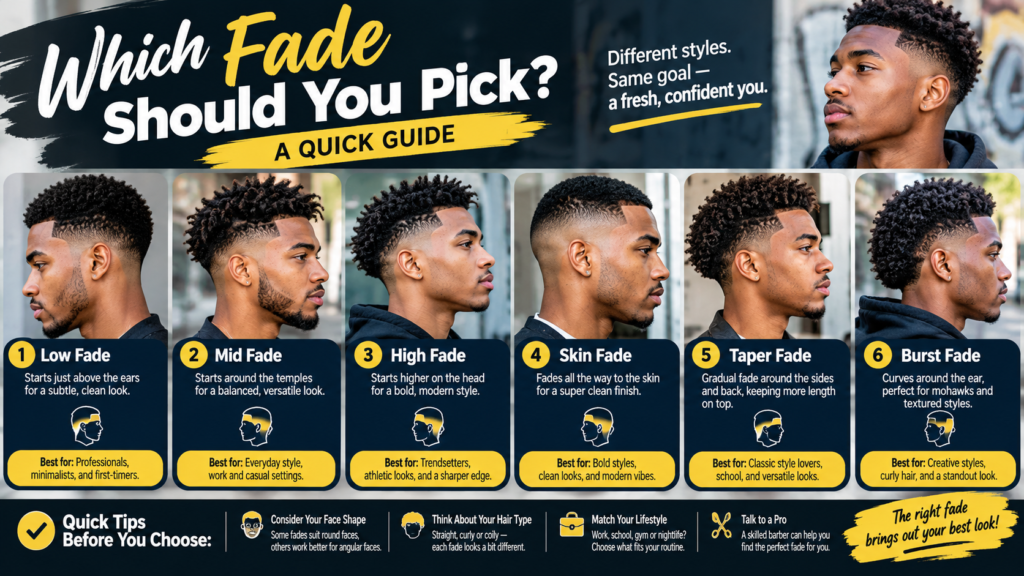
Still undecided? Match your priority to a starting point.
- Easiest and safest: low fade or taper fade with a natural hairline.
- Best all-rounder: mid fade with a sharp line-up.
- Maximum contrast: high skin fade or bald fade.
- Longest between cuts: low fade or taper fade.
- Best for waves: low or mid fade with short, brushed hair on top.
- Best for volume: high or burst fade under curls, an afro or a high top.
- Best with a beard: drop, mid or skin fade that blends into the beard line.
- Lowest daily effort: buzz cut fade or short fade.
If you are unsure, start one step softer than you think you want. You can always ask your barber to go shorter next visit, but you cannot add hair back.
Fade and Beard Combinations
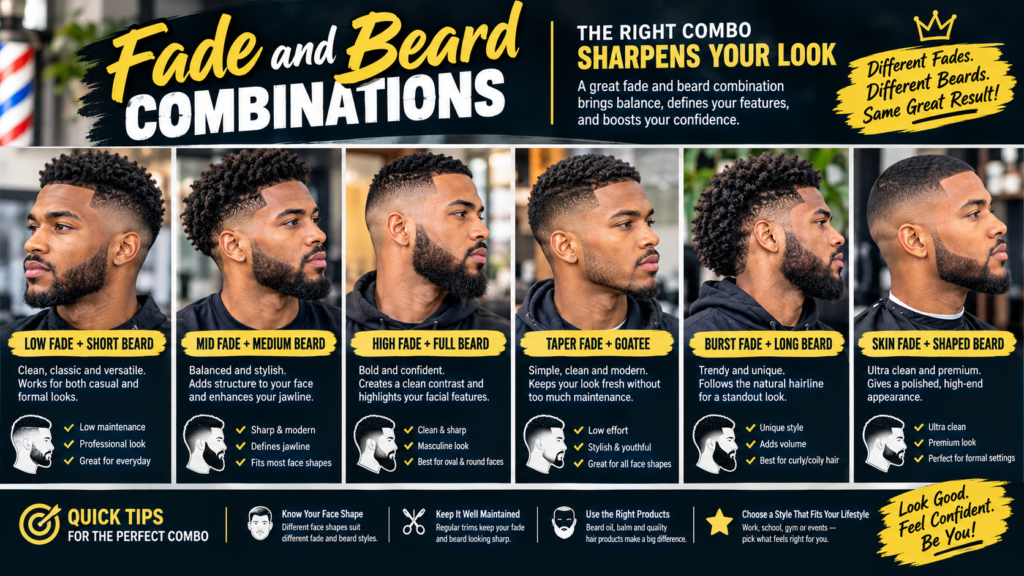
A fade and a beard should look like one design. The fade ends where the beard begins, so the transition needs to be smooth.
- Skin fade with a short beard. The beard starts at the sideburn and the skin blends straight into it. Bold, sharp and modern.
- Low fade with a full beard. The fade stays higher on the sides, so the beard has room to look full without crowding the cut.
- Drop fade with a shaped beard. The curve of the fade follows the jawline and ties the whole face together.
- Temple faded with a beard. A tight temple blend frames the face, and a crisp cheek line keeps the beard clean.
- Fade with a goatee or chinstrap. A lighter option when you want definition without a full beard.
Keep the cheek line and neck line sharp. Ask your barber where to place the neck line: usually about one finger above the Adam’s apple. Trim a little between visits, but leave the lines to a professional.
How to Get and Keep 360 Waves
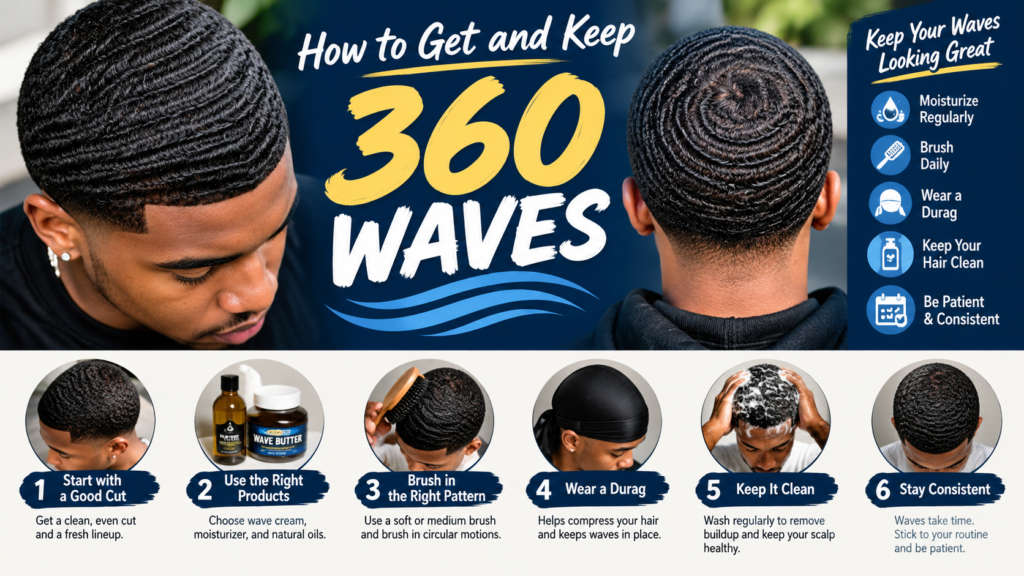
Waves take patience, but the routine is simple. Most men see a pattern form within four to eight weeks, and deeper waves take longer.
- Start with a short, even cut. A low or mid fade with a very short top gives the pattern room to show.
- Moisturise first. Apply a light leave-in or oil so the hair is soft and easy to train.
- Brush in layers. Use a soft boar-bristle brush and move in the direction the waves should lie, from the crown outward.
- Use a small amount of pomade. Too much leaves residue and flakes.
- Cover with a wave cap. Wear it for 30 minutes to an hour while brushing, then a durag or satin cap overnight.
- Brush often. A few sessions a day work better than one long session.
- Keep your cuts consistent. The fade and line-up need regular upkeep so the waves look intentional.
Waves react to dryness and rough handling. Skip harsh shampoos, avoid scratching and stay patient through the early weeks.
A Simple Weekly Routine Between Cuts
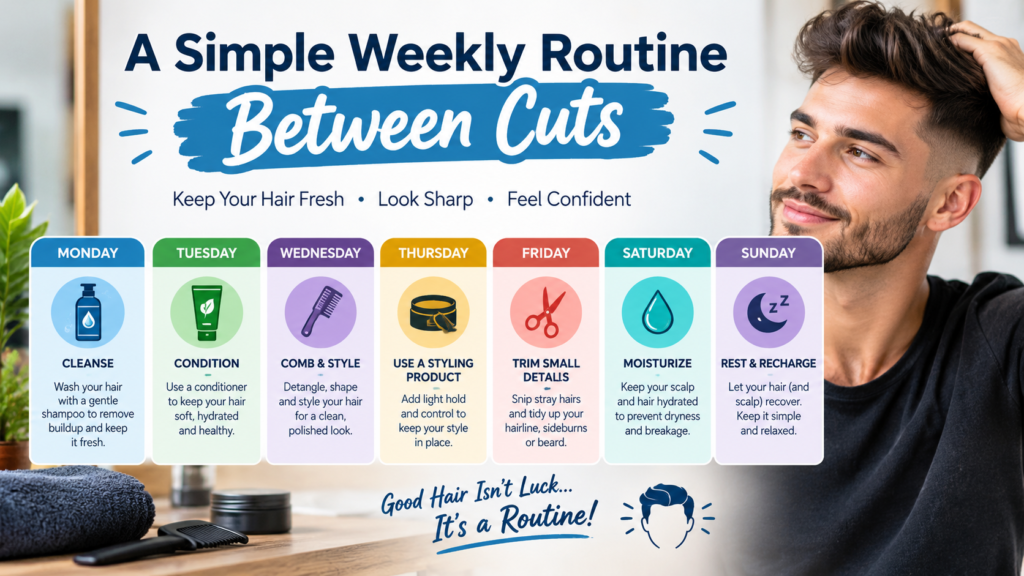
A routine keeps your fade fresh and your hair healthy. Adjust it for your texture.
- Daily: moisturise hair and scalp with a leave-in or light oil. Brush waves or shape curls. Cover your hair at night.
- Two or three times a week: wash with a gentle, moisturising shampoo and condition. Wash waves less often so the pattern stays trained.
- Weekly: apply a deep conditioner or hair mask, especially if you bleach or colour your hair. Check the hairline and beard lines for growth.
- Every one to three weeks: book a barber visit or a quick line-up, depending on your fade.
- As needed: clean your brush and cap, and replace your durag or bonnet when it wears out.
Even a five-minute routine makes a visible difference. A fade only looks as good as the hair and skin underneath it.
Common Fade Myths
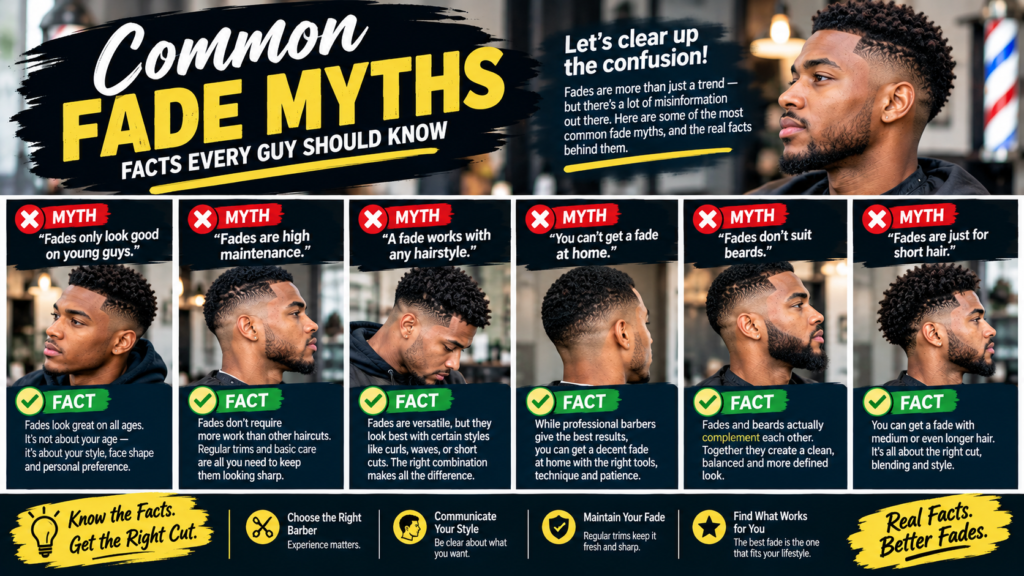
- “Fades only suit certain hair types.” Fades work on curls, coils, waves, locs and afros. The fade height and top style change with texture.
- “A skin fade is always best.” Skin fades give the most contrast, but they need the most upkeep. A low or taper fade often suits busy schedules better.
- “A fade is unprofessional.” A low or taper fade with a neat line-up looks polished in almost any workplace.
- “Shaving more makes the hairline look better.” Pushing the line back too far can look unnatural and leave you with less to work with. A natural hairline usually ages better.
- “You can fix a fade at home.” Small touch-ups may help, but a proper blend takes training, the right tools and a clear view of the back and sides.
- “Fades damage hair.” The cut itself does not. Dryness, harsh products and rough handling do.
Questions to Ask Before the Cut Starts
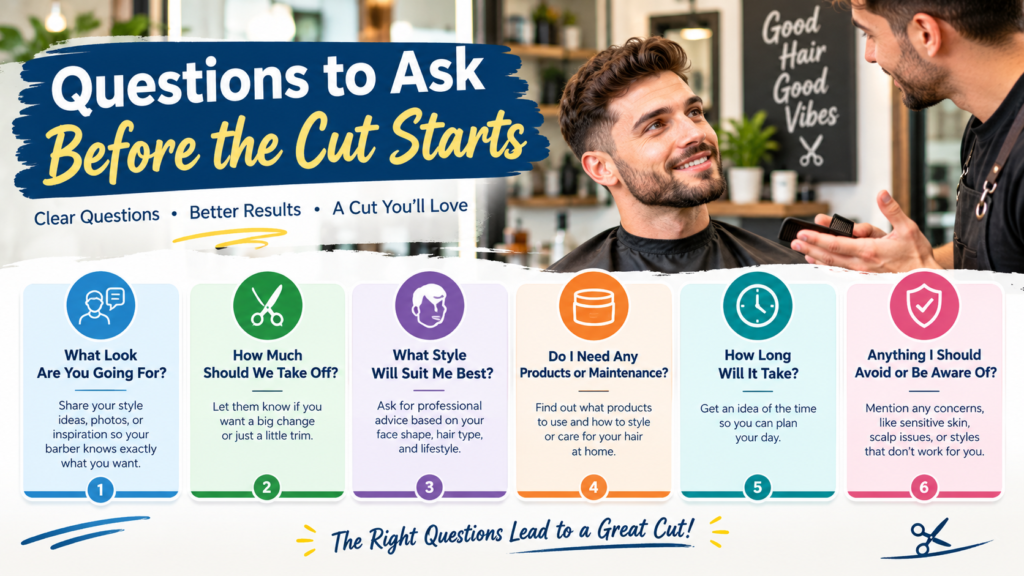
A short conversation before the clippers turn on prevents most mistakes.
- Which fade height suits my face shape and top length?
- Which guard numbers will you use, and where will the fade start?
- How will you shape my hairline: natural, soft or sharp?
- How should I style or maintain this cut at home?
- How often should I come back to keep it looking sharp?
Good barbers like these questions. They show you care about the result, and they help the barber match the cut to your hair, your routine and your style.
Fades for Thinning Hair and Receding Hairlines
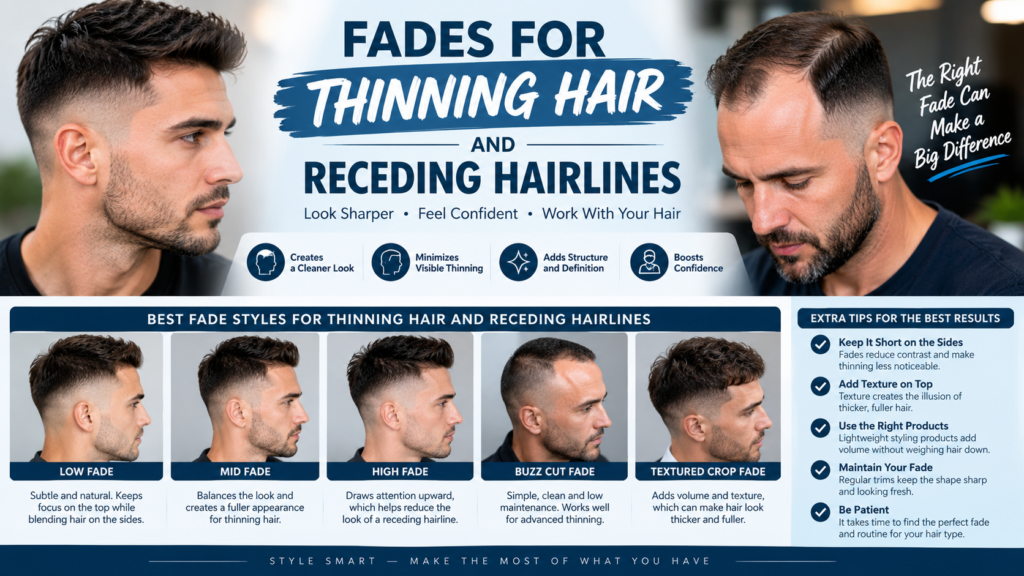
A fade can make thinning hair look intentional and tidy. The goal is to reduce the contrast between thin areas and the rest of the head.
- Go shorter on top. A short crop or buzz cut fade makes thinning areas less noticeable than a longer top that exposes the scalp.
- Choose a low or taper fade. A high skin fade draws attention to the temples. A softer blend keeps the focus on the overall shape.
- Keep the hairline natural. A line-up that follows your real hairline looks better than one pushed back to hide recession.
- Add a beard. A well-shaped beard balances the face and shifts attention downward.
- Use texture. A matte styling product or fibre adds the look of fullness without shine.
- Talk to a professional. If you notice sudden or patchy hair loss, see a doctor or dermatologist to understand the cause.
Fade Care by Season
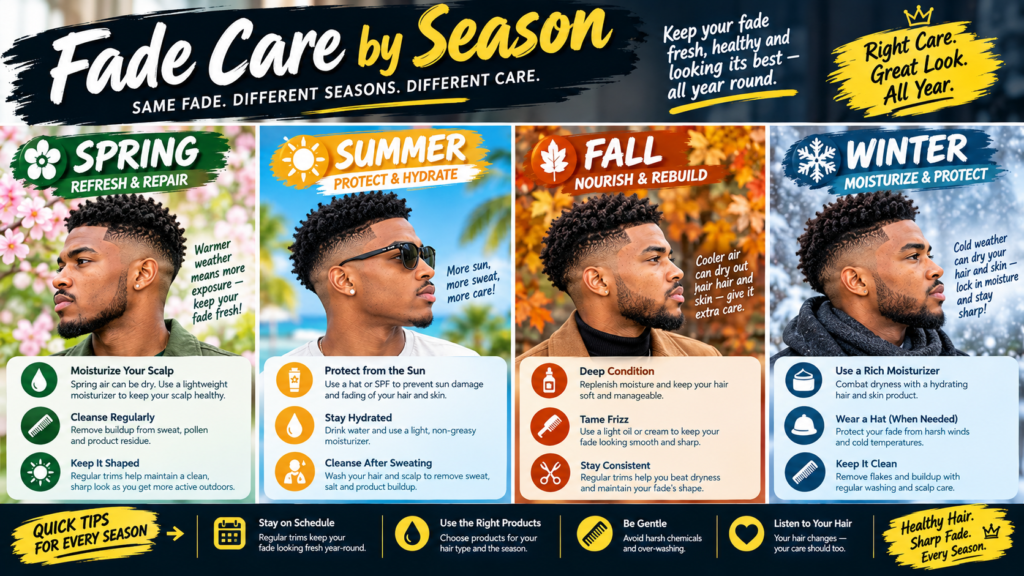
Weather affects hair and skin. A few small changes keep your fade looking its best all year.
- Summer. Short sides keep you cool. Use sunscreen on exposed skin and rinse sweat and chlorine out of your hair, because both dry it quickly.
- Winter. Cold air and indoor heating dry the scalp. Use richer moisturisers, cover your hair when you go outside and avoid very hot showers.
- Rainy or humid weather. Humidity can frizz waves and curls. A light sealing oil and a cap help hold the shape.
- Travel. Pack your brush, a satin cap and a small leave-in. Book a line-up before a trip or event so you arrive looking sharp.
Reference Photos: What to Bring
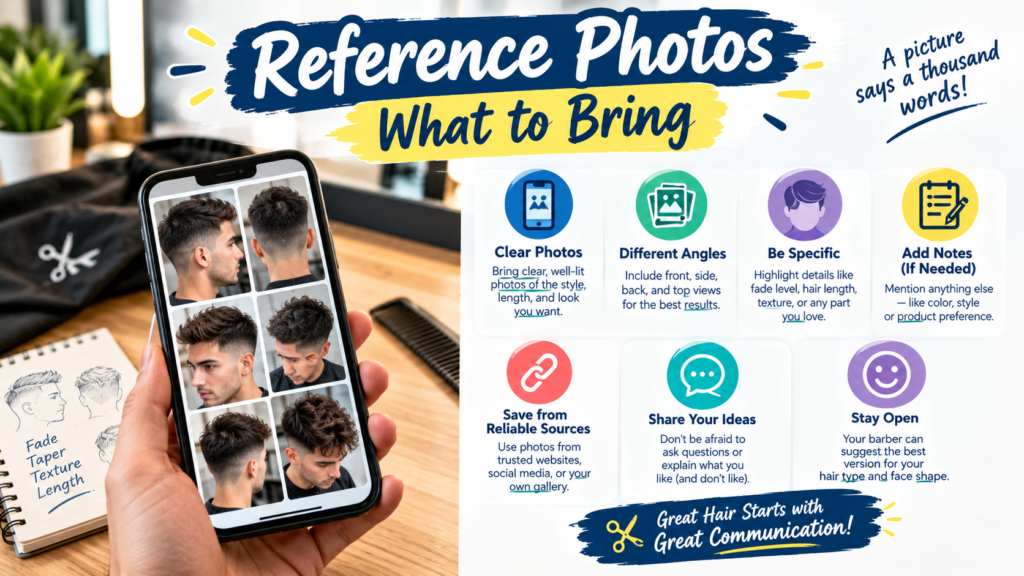
A good reference photo saves a lot of explaining. Choose photos that match your reality, not just a style you like.
- Same hair type. Pick people with a texture similar to yours, so the result is realistic.
- Several angles. Front, side and back views show where the fade starts and how it blends.
- The top as well as the sides. Show the length and shape you want on top.
- Close-ups of details. A photo of the line-up or hard part makes your request clear.
- A “no” photo. If there is a look you do not want, show that too.
Tell the barber what you like about the photo. It may be the height of the fade, the sharp line-up or the shape of the top. That helps them adapt the idea to your face and hair.
Final Checklist Before Your Next Fade
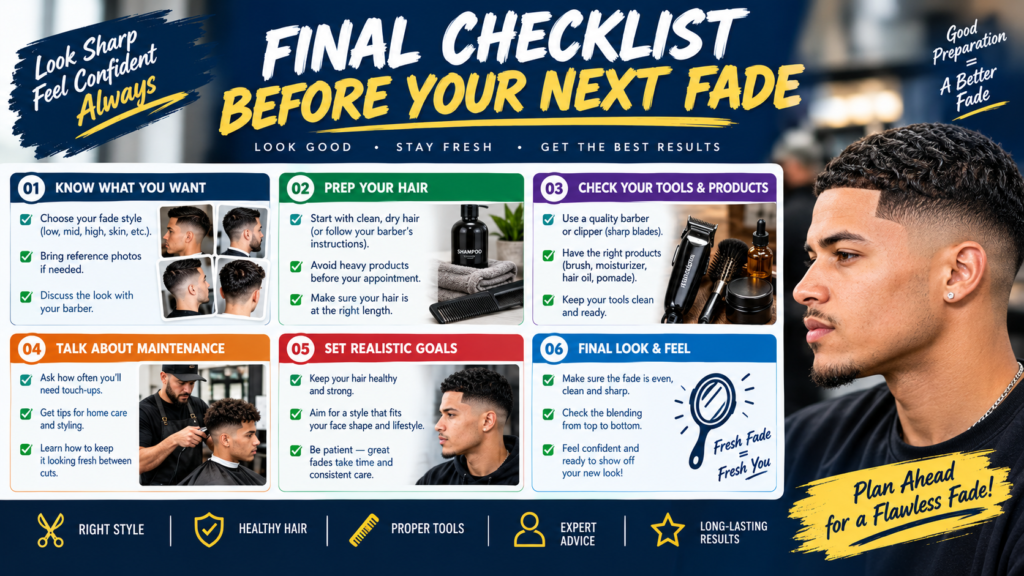
- Decide the fade height: low, mid or high.
- Decide the finish: skin, short guard or taper.
- Choose the top style and length.
- Decide on a line-up and how sharp you want it.
- Plan your beard blend, if you have one.
- Save two or three reference photos.
- Book your next visit before you leave the shop.
- Set up a night cap and a daily moisture routine.
Frequently Asked Question’s
What is the best fade haircut for black men?
The mid fade with a sharp line-up is the safest all-round choice. It suits most face shapes and hair types.
What does a fade haircut mean?
Hair gradually shortens from the top down to the skin or a very short length.
What is the difference between a fade and a taper?
A fade blends over a larger area and often reaches the skin. A taper only trims the edges and neckline.
Which fade is best for 360 waves?
A low or mid fade frames the pattern best and keeps it clean.
How often should I fade?
Every one to two weeks for skin fades, and every two to four weeks for low fades or tapers.
Is a skin fade good for black men?
Yes. It gives the sharpest contrast and shows off the texture and shape on top.
What fade is best for a round face?
A high or mid fade with volume on top makes a round face look longer.
Can I get a fade with natural afro hair?
Yes. An afro with a low, mid or drop fade looks neat and bold.
How do I keep my fade looking fresh?
Moisturise daily, protect your hair at night and book regular barber visits.
What should I tell my barber?
Say the fade height, the length on top, the type of line-up and whether you want it blended into your beard.
Conclusion
A fade is more than a trend. It is a flexible, well-loved cut that brings sharp lines and confidence to black men’s hairstyles.
You now know the main types, 45 style ideas, and how to match a fade to your hair, face shape and lifestyle, plus how to talk to your barber and keep the cut fresh.
Start with the height that feels right. Bring a photo. Keep your hair moisturised. Then enjoy the look.
Ready for a new cut? Pick one style from this list, show it to your barber, and book your next fade today.

Ronan Mercer is a measurement focused content writer and researcher at Only Faxhion. He creates clear, practical articles about units, sizes, dimensions, conversions, and measurement concepts, helping readers understand everyday measurement topics through well researched and easy to follow explanations.