
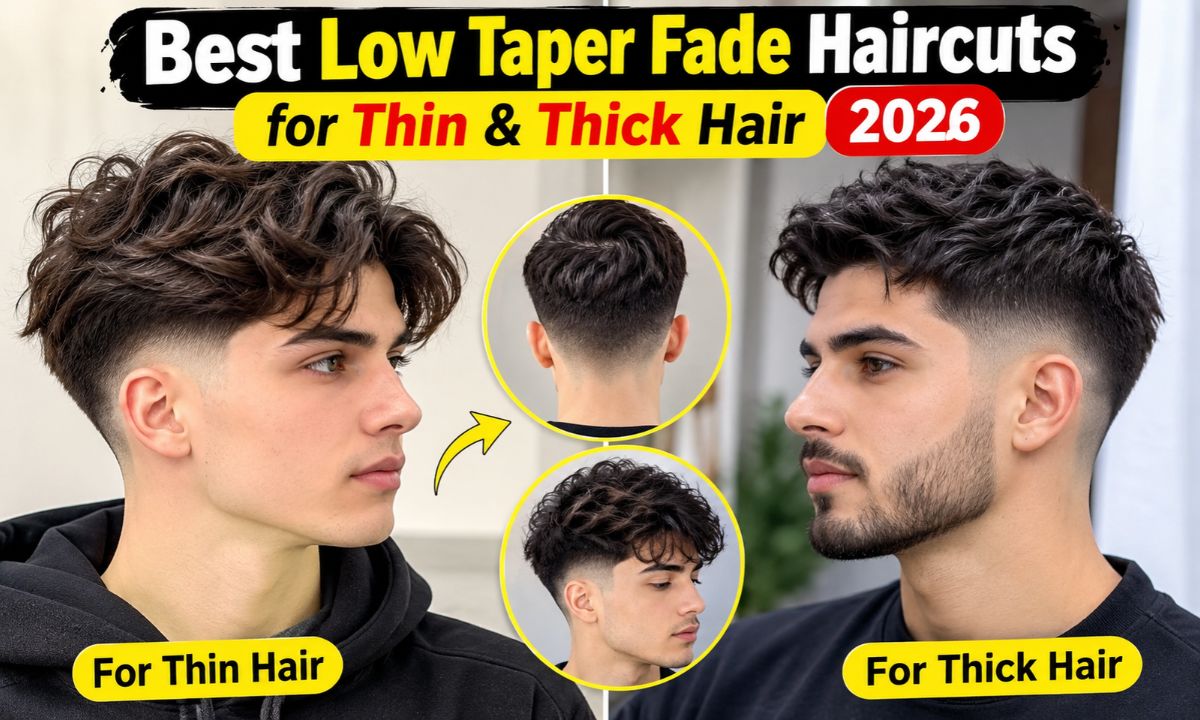
A low taper fade is one of the cleanest and most popular men’s haircuts in 2026. It keeps the sides short and neat while the top stays long enough to style. The cut looks sharp at work, at school, and at any event.
The best part is that it works on almost every hair type. The barber only needs to adjust the blend, the guard size, and the top length to match your density. This guide shows you the right version for thin hair and thick hair, plus barber scripts, styling tips, and smart alternatives.
What a low taper fade is
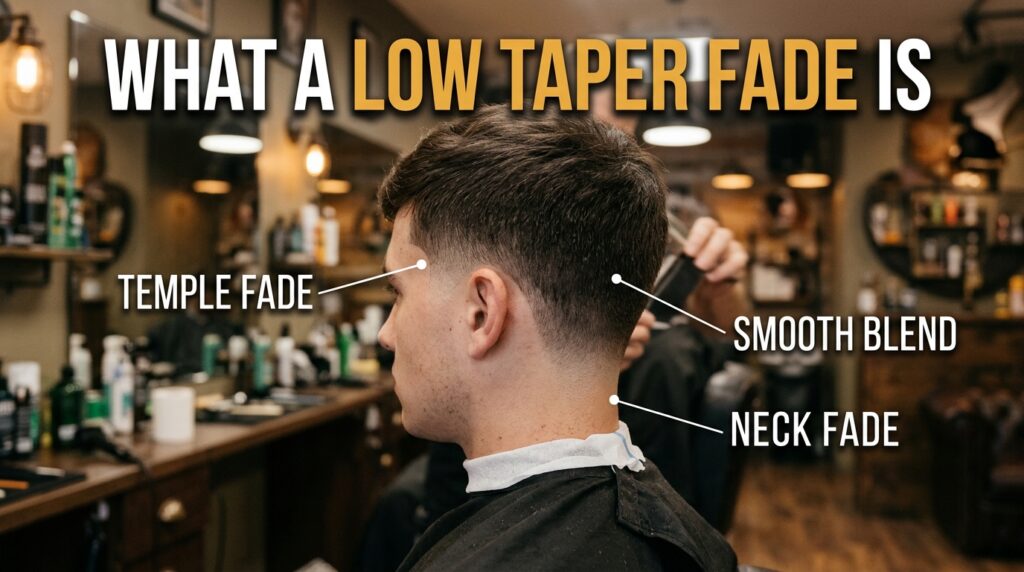
A low taper fade is a short haircut where the sides and back get shorter as they move down toward the neck and ears. The change starts low, near the ear and the nape. The top and upper sides stay longer and natural.
The cut looks sharp but not extreme. That is why it fits school, office, gym, and weddings equally well. It is one of the safest fades you can ask for.
Taper, fade, and low taper fade: how barbers use the terms
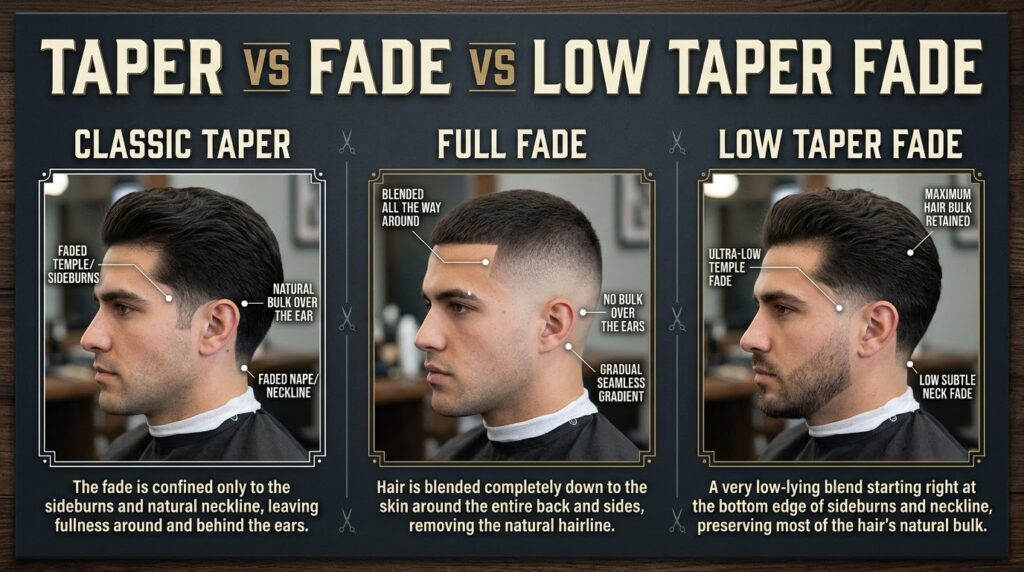
Barbers use these words in a slightly different way than most clients do. Here is a simple breakdown.
- Taper: A gentle length change. The hair gets shorter slowly, and it often stops at a visible length, not at bare skin.
- Fade: A bigger change in length. The hair blends down to very short stubble or skin.
- Low taper fade: A mix of both. It starts low on the head and blends softly around the ear and neckline.
Many clients say “fade” when they mean “taper.” Always tell your barber how short you want the bottom to go. That one detail avoids most bad surprises.
| Term | Length change | Skin shows? | Best for |
| Taper | Soft and gradual | Rarely | Classic, neat look |
| Fade | Strong and fast | Often | Sharp, modern look |
| Low taper fade | Soft to medium | Sometimes | Easy daily wear |
How fade height and placement change contrast
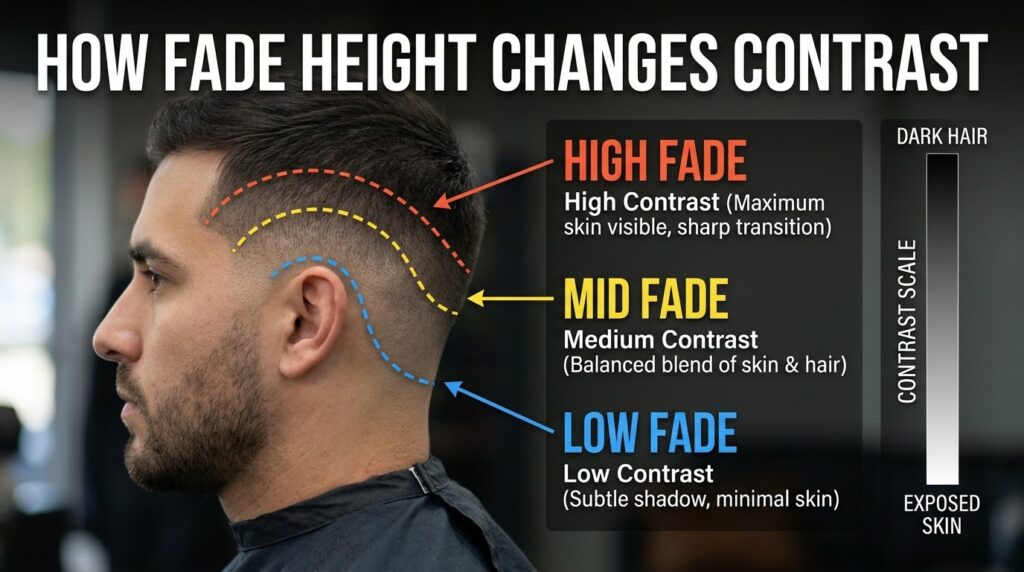
Fade height decides how much contrast you see. A low fade keeps the dark and light zones close together. A mid or high fade creates a stronger gap.
Low placement keeps more hair on the sides. That adds weight and softness around the face. Higher placement removes more hair and makes the top stand out more.
Here is a quick guide to how height changes the final look.
| Fade height | Starts at | Contrast | Feel |
| Low | Just above the ear and nape | Low | Soft and tidy |
| Mid | Around the temple level | Medium | Balanced and modern |
| High | Above the temple | High | Bold and edgy |
Is a low taper fade good for thin and thick hair?
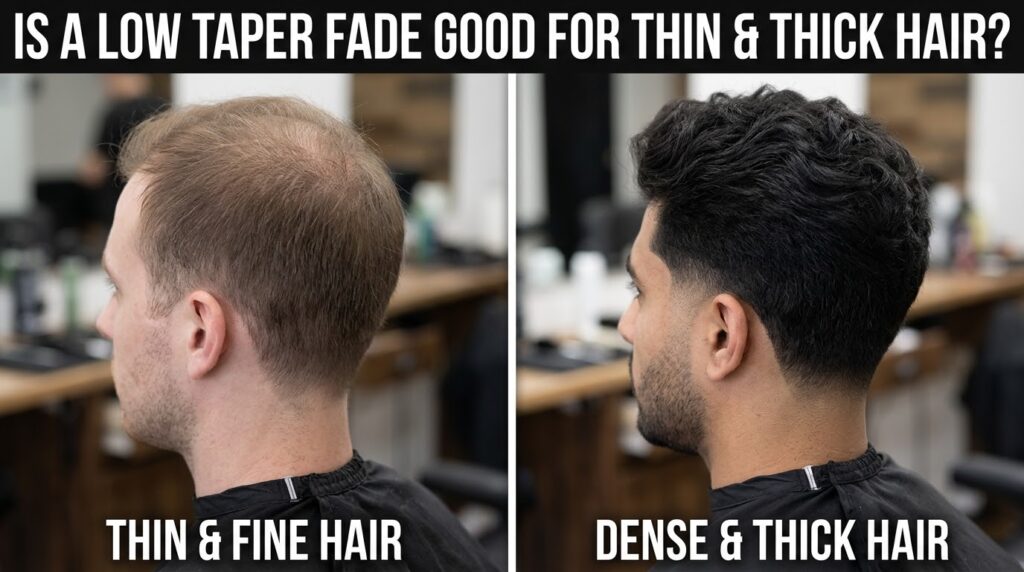
Yes, a low taper fade is good for both. It is one of the few cuts that adapts well. Thin hair keeps more side coverage. Thick hair gets controlled bulk.
The key is not the fade itself. The key is how the barber handles the top, the blend, and the length at the sides. A good barber will change the plan based on your hair type.
How to tell fine, low-density, thinning, and thick hair apart
People mix up these terms all the time. They are not the same thing, and each one needs a different approach.
- Fine hair: Each strand is thin. You may have plenty of strands, but the hair feels soft and light.
- Low-density hair: You have fewer strands per square inch. Scalp shows through easily.
- Thinning hair: Hair is getting less dense over time. This often happens at the temples, crown, or top.
- Thick hair: Each strand is wide, or you have many strands, or both. The hair feels heavy and full.
A simple home test helps. Pull your hair into a ponytail and feel the width. A thin ponytail means low density. A thick ponytail means high density. Then roll a single strand between your fingers. If you barely feel it, your strands are fine.
| Hair type | Strand size | Scalp visibility | Common challenge |
| Fine | Thin | Medium | Flat, limp top |
| Low-density | Any | High | See-through look |
| Thinning | Any | Growing | Weak hairline or crown |
| Thick | Wide | Low | Bulk and puffiness |
The best low taper fade for thin or thinning hair
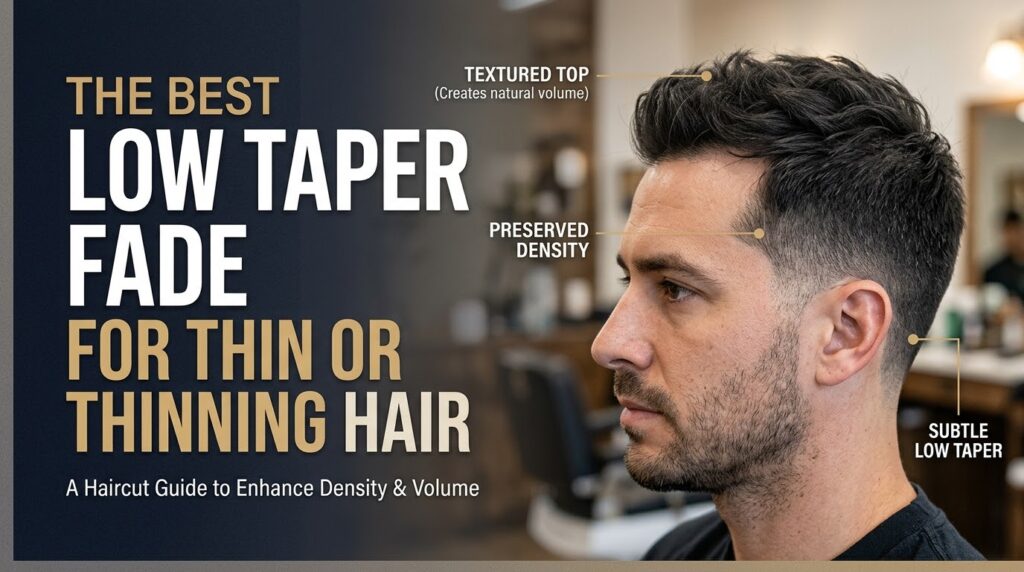
For thin hair, the goal is to look fuller. A soft low taper does that well. It keeps hair on the sides, so the head looks balanced and less see-through.
Keep the fade gentle. Avoid taking the skin too high. Leave enough length on top to build texture. Use a matte product, not a shiny one.
Barber adjustments that preserve fullness
Small barber choices make a big difference on thin hair. Ask for these changes.
- Start the taper low, near the ear and neckline.
- Leave the sides a little longer, such as a number 2 or 3 guard at the top of the blend.
- Avoid skin fades unless you want a very sharp look.
- Keep the top at two to four inches so hair can lift.
- Ask for light texturizing, not heavy thinning shears.
- Skip deep layers that cut away density.
A longer top gives you something to style. A softer side keeps contrast low. Low contrast hides thin spots because the eye sees one smooth shape.
Best top styles for thin hair
Some top styles add the look of volume. Others make thin hair look weaker. Pick the right one.
- Textured crop: Short, messy, and full of movement. It hides the scalp well.
- Side part with soft volume: Clean but not flat. Works well for work settings.
- Forward fringe: Brushed forward with a light texture. It covers a high forehead.
- Short quiff: Lifted slightly at the front. Best for medium length.
- Natural messy top: Air-dried and lightly styled for a relaxed look.
| Top style | Length | Best for | Product |
| Textured crop | 1 to 2 inches | Fine, thinning hair | Matte clay |
| Side part | 2 to 3 inches | Office wear | Light cream |
| Forward fringe | 2 to 3 inches | Receding temples | Sea salt spray |
| Short quiff | 3 to 4 inches | Low-density hair | Volumizing powder |
Mistakes that expose more scalp
Some choices make thin hair look thinner. Avoid these.
- Asking for a high skin fade that removes side density.
- Cutting the top too short and flat.
- Using heavy wax or gel that clumps strands together.
- Combining hair straight back with no volume.
- Over-washing and leaving hair dry and weak.
- Letting the barber thin the top with shears.
Clumped hair shows more scalp. Use only a small amount of product. Rub it between your palms first. Then work it through dry hair.
The best low taper fade for thick hair
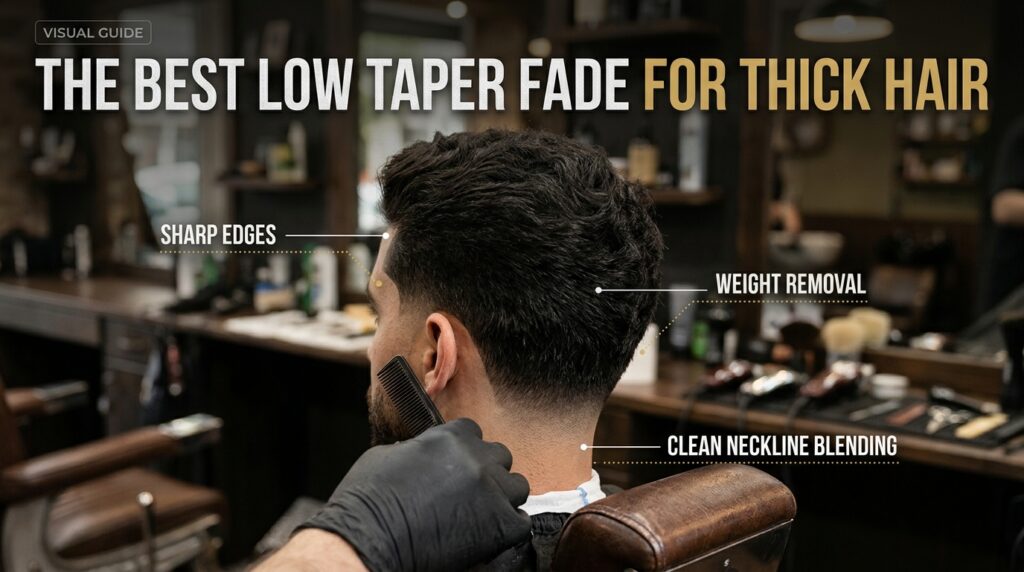
Thick hair holds shape well, but it can look wide and heavy. A low taper fade controls the sides and keeps the head shape clean. It also makes styling much faster.
On thick hair, the barber must manage bulk. The blend should be smooth, and the top should be shaped so it does not sit like a helmet.
Barber adjustments that remove bulk without losing shape
Thick hair needs smart weight removal. Ask your barber for these steps.
- Start the taper low but blend it well into the heavier sides.
- Use clippers over comb to avoid hard lines.
- Ask for point cutting or slide cutting to thin the top.
- Keep the shape square or oval, not round.
- Remove weight around the ears so hair does not flare out.
- Clean the neckline with a soft, natural edge.
Do not remove too much from the top. You want a shape, not a flat surface. A balanced cut grows out better.
Best top styles for thick, wavy, curly, or coily hair
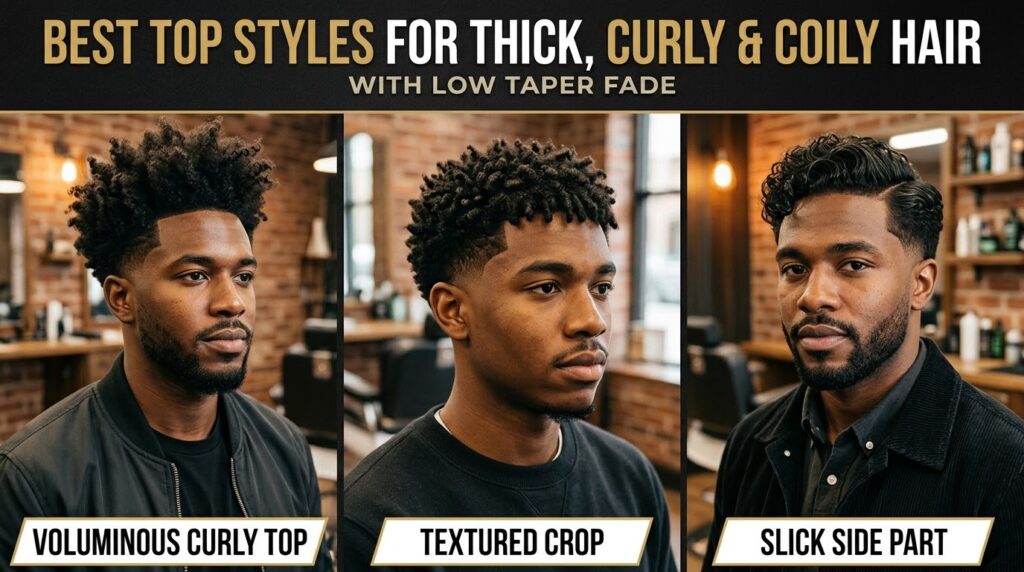
Thick hair comes in many textures. The top style should match your pattern.
- Classic side part: Neat and sharp on straight or wavy hair.
- Textured quiff: Adds height and works on thick straight hair.
- Curly top with taper: Keeps curls defined while the sides stay neat.
- Coily twist top: Twists or sponge curls on top with a clean low taper.
- Short waves: Brushed waves with a soft fade on the sides.
- Natural afro with low taper: Full on top with a crisp edge at the sides.
| Hair texture | Top style | Product | Finish |
| Straight thick | Quiff or side part | Pomade | Medium shine |
| Wavy | Textured top | Cream or clay | Natural |
| Curly | Curly top | Curl cream | Defined curls |
| Coily | Twist or sponge top | Curl butter | Moisture and shape |
Bulk, puffing, and difficult grow-out
Thick hair can puff up as it grows. The taper loses its shape fast. The sides push outward and look wide.
You can slow this down. Get regular trims. Use a light oil or cream to keep hair smooth. Ask the barber to remove inner weight on the sides so the hair lies flat.
Grow-out is easier when the fade starts low. The line does not jump out. Hair simply gets longer from the bottom. If you plan to grow your hair, tell your barber early so the cut can be planned for that.
See More : Mid Taper vs Low Taper
Thin vs thick hair: what should your barber change?
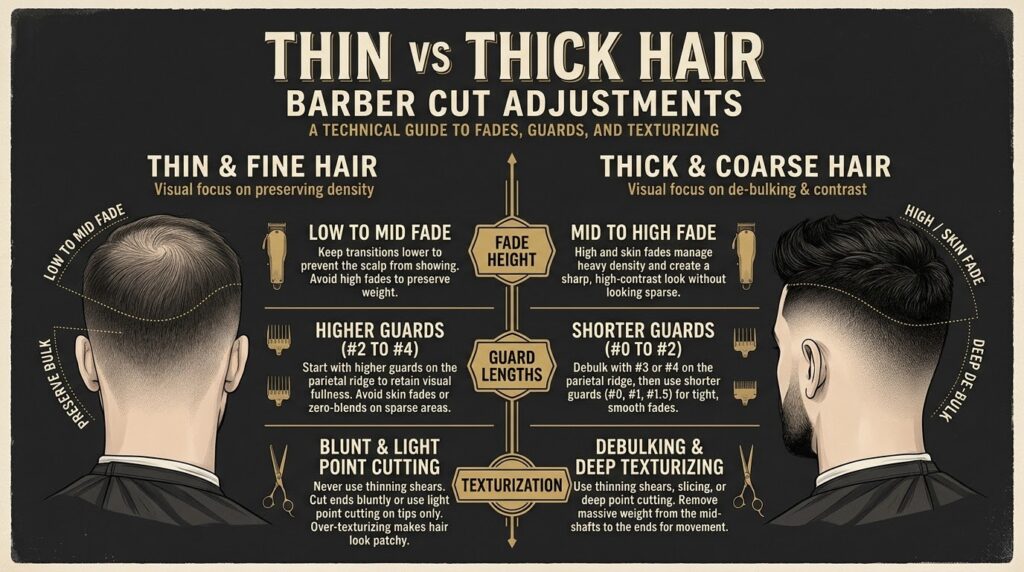
The same low taper fade should look different on thin and thick hair. A good barber changes the plan. Here is a side-by-side comparison.
| Feature | Thin or fine hair | Thick or high-density hair |
| Fade start | Very low | Low, with careful blending |
| Side length | Slightly longer | Shorter and controlled |
| Top length | 2 to 4 inches | 2 to 5 inches |
| Texturizing | Light only | Needed to remove bulk |
| Product | Matte, light | Cream, pomade, or curl cream |
| Goal | Look fuller | Look neat and light |
Thin hair needs help looking fuller. Thick hair needs help looking lighter. Keep that rule in mind and the cut will work.
Non-negotiables of a clean low taper
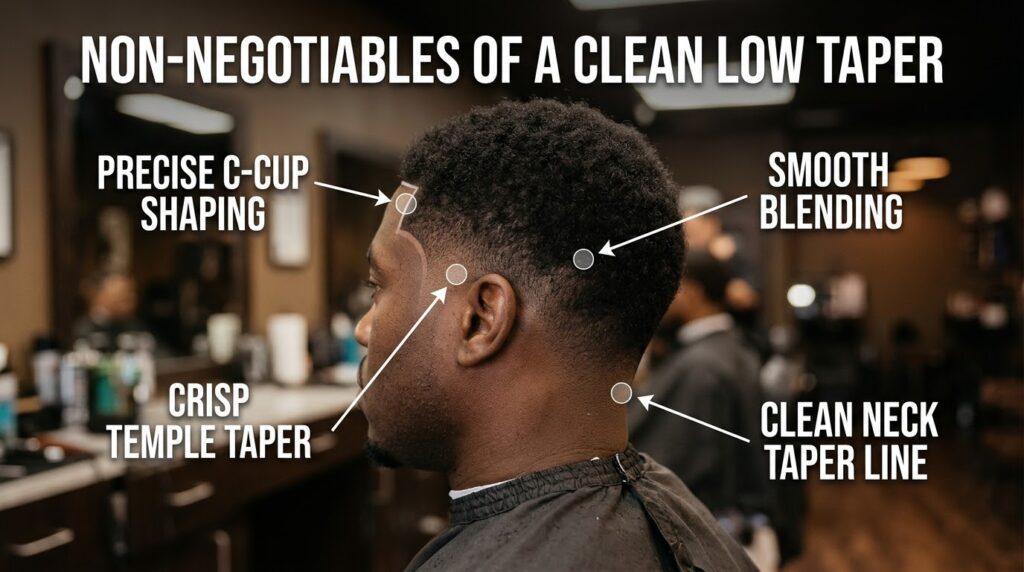
Some things should be right on every low taper. Do not accept less.
- A smooth blend with no visible lines.
- A balanced shape from both sides.
- A clean neckline, rounded or squared based on your preference.
- Even ear arches with no jagged edges.
- A top length that fits your hair type.
- A fade that suits your head shape and hairline.
Check the mirror at the end. Ask the barber to show you the back. Look for harsh lines or uneven spots. Speak up before you leave the chair.
How to ask your barber for a low taper fade
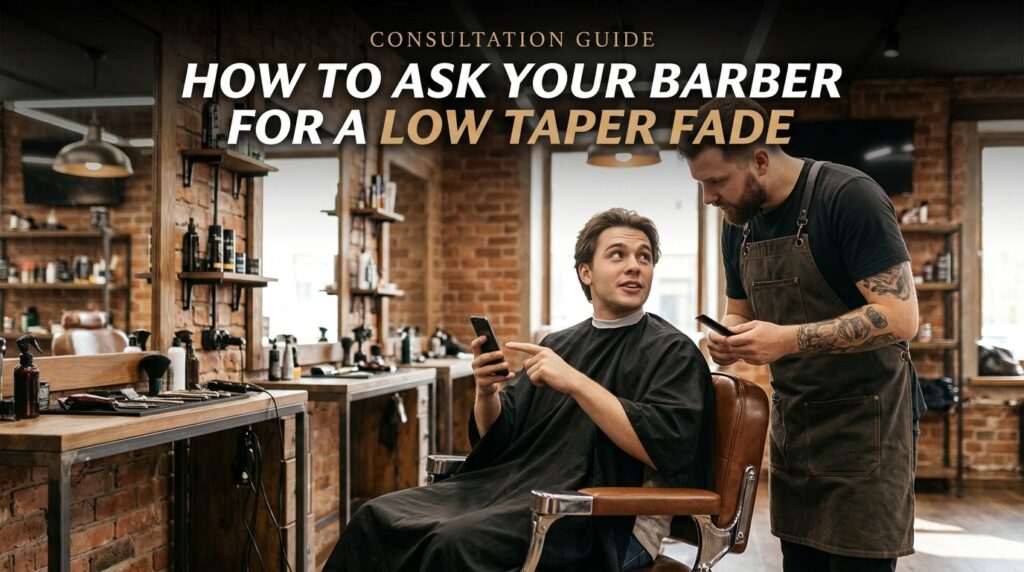
Many bad haircuts come from poor communication. Clear words fix that. Tell the barber three things: the fade height, the bottom length, and the top style.
Bring one or two photos. Photos remove guesswork. Also say what you do not want, such as a skin fade or a very short top.
Thin, fine, or thinning hair script
Use this simple script at the shop.
“I have thin hair and I want it to look fuller. Please give me a low taper fade with a soft blend. Keep the sides a bit longer, around a number 2 at the shortest. Leave the top around three inches and add light texture. Please do not use thinning shears.”
You can also add, “I want a natural look that is easy to style in the morning.” Short and clear is best.
Thick or high-density hair script
Use this script if your hair is thick.
“I have thick hair and I want it to look neat. Please give me a low taper fade with a smooth blend. Take down the bulk on the sides and around the ears. Keep the top at about three inches with some weight removed so it sits well. Please clean the neckline.”
For curly or coily hair, add, “Please cut my curls dry so I can see the shape.” This helps the barber see how the hair really falls.
Reference-photo and consultation checklist
Use this checklist before the first clipper touch.
- Bring two or three photos of the style you like.
- Choose photos with a similar hair type to yours.
- Say how short you want the bottom of the fade.
- Mention your hairline concerns, if any.
- Tell the barber how much time you spend styling.
- Ask which products they suggest for your hair.
- Confirm the neckline shape: rounded, squared, or natural.
- Ask how often you should come back.
| Question to ask | Why it matters |
| What guard will you start with? | Avoids a cut that is too short |
| Will you thin the top? | Protects thin hair from over-cutting |
| How will this grow out? | Helps plan your next visit |
| Which product suits me? | Makes styling easier |
How to style and maintain a low taper fade
A good cut still needs good care. The fade will look fresh for two weeks if you style it well. After that, the lines start to soften.
Keep your routine short. Wash, dry, style, and go. Use the right product for your hair type. Too much product is the most common mistake.
Daily routine for thin or fine hair
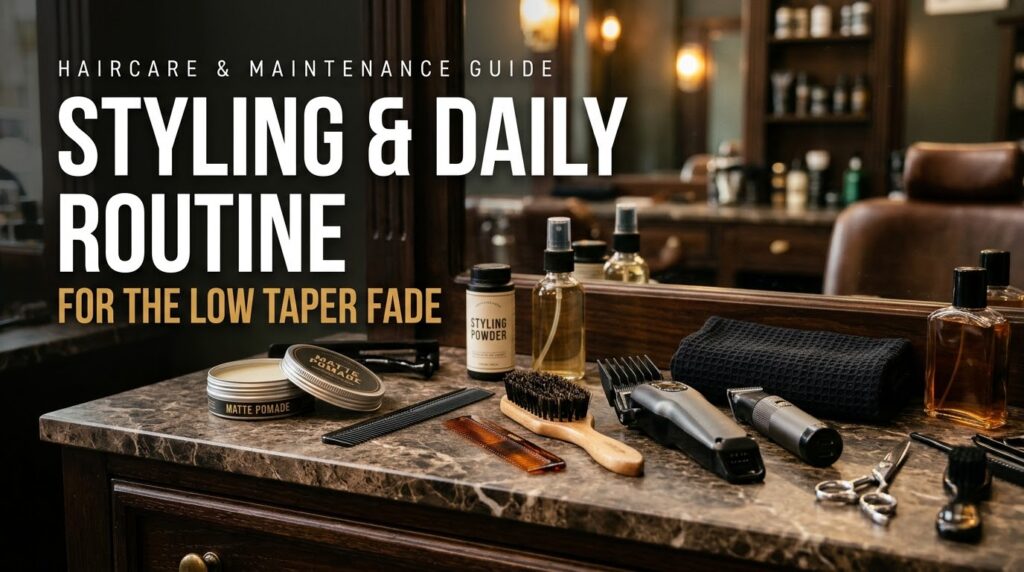
Thin hair needs light care. Follow these steps.
- Wash with a gentle, volumizing shampoo two or three times a week.
- Use a light conditioner on the ends only.
- Towel dry, then blow dry with the hair lifted at the roots.
- Apply a pea-sized amount of matte clay or sea salt spray.
- Style with your fingers and set with a cool blast of air.
Avoid heavy gels and oils. They weigh hair down. Keep the hair clean so it keeps its lift.
Daily routine for thick, coarse, curly, or coily hair
Thick hair needs more moisture and control.
- Wash two to three times a week with a moisturizing shampoo.
- Use conditioner every wash, from mid-length to ends.
- Apply a leave-in cream or curl cream to damp hair.
- Style with a comb, brush, or fingers based on your texture.
- Finish with pomade, clay, or oil for hold and shine.
Coily hair needs extra care. Use a satin scarf or pillowcase at night. It keeps the hair soft and cuts down on frizz.
| Step | Thin or fine hair | Thick or coily hair |
| Shampoo | Volumizing | Moisturizing |
| Conditioner | Light, ends only | Rich, every wash |
| Styling | Matte clay | Cream, pomade, or butter |
| Night care | None needed | Satin scarf or pillowcase |
Touch-up schedule and clean grow-out
Fades fade fast. The sides grow quickly, and the blend loses its shape. A regular schedule keeps the cut sharp.
- Every 2 weeks: Best for a crisp, fresh look.
- Every 3 to 4 weeks: Good for a softer, natural look.
- Every 5 to 6 weeks: Only if you are growing the hair out.
For a clean grow-out, keep the low taper. Let the top grow, and tidy the neckline every few weeks. This keeps you looking neat while the length builds.
When is a low taper fade a poor choice?
A low taper fade is not perfect for everyone. Some hair situations make it a weaker option. Knowing this saves you from a regret haircut.
If your hair is very thin on top, a fade can create a sharp contrast. That draws the eye to the weak area. In that case, a different style may work better.
When the cut can make hair look thinner
A low taper can backfire in these cases.
- Your top is very sparse and the sides are dense.
- Your scalp shows clearly through the top hair.
- You choose a very short top with a skin fade.
- Your hair is patchy and uneven.
- You use shiny products that reveal the scalp.
The fade makes the sides short. If the top is also thin, the head looks bare. A longer, softer cut gives better coverage.
Hairline, crown, and cowlick issues versus medical signs
Not every hair problem is a style problem. A cowlick is normal. It is a patch of hair that grows in a different direction. A skilled barber can cut around it.
A weak hairline or crown is different. It may come from genetics, stress, or health. Watch for these signs.
- Hair falling out in clumps.
- A hairline that moves back quickly.
- Bald patches that appear suddenly.
- Itchy, red, or painful scalp.
- Hair that gets much thinner over a few months.
If you see these signs, talk to a doctor or a skin specialist. A haircut cannot fix a medical problem. Early care gives better results.
| Issue | Likely cause | What to do |
| Cowlick | Natural growth pattern | Ask barber to cut around it |
| Slow thinning | Genetics or age | Choose a flattering cut and see a doctor |
| Sudden hair loss | Stress or health | See a doctor soon |
| Itchy scalp | Dandruff or skin issue | Use proper care and consult a pro |
The best alternatives when a low taper is not ideal
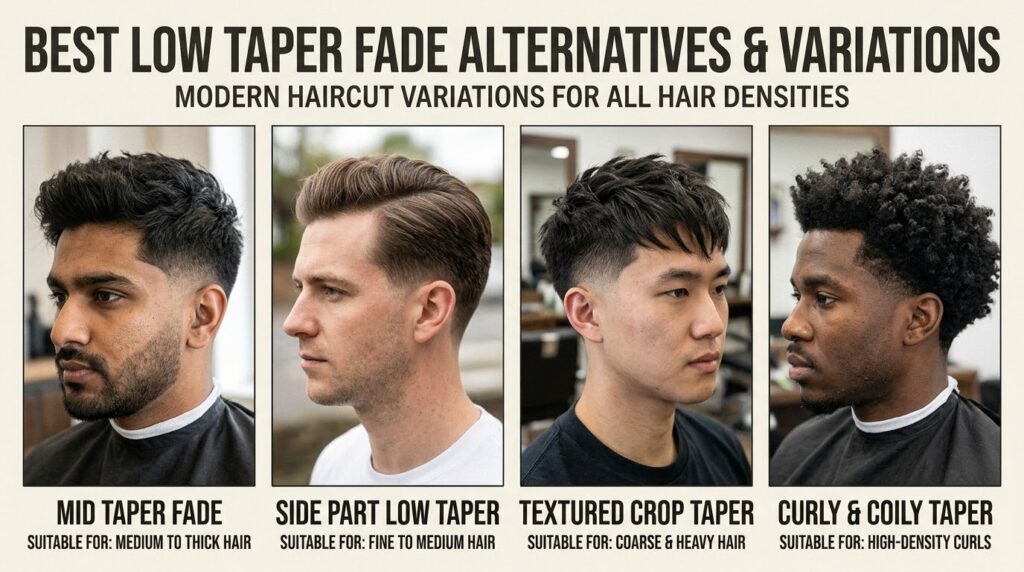
If a low taper does not suit you, you still have great options. Many other cuts look sharp and work for your hair type.
The right alternative depends on density. Let us look at both sides.
Alternatives for thin or thinning hair
These options help thin hair look fuller.
- Classic taper: A softer version that leaves more hair at the sides.
- Scissor cut with a light taper: Gentle and natural.
- Buzz cut: Short and even. It hides thinning very well.
- Crew cut: Neat with a longer front.
- Short textured crop with a scissor-cut side: Soft and full looking.
A buzz cut is often the best answer to thinning. It removes contrast. The whole head looks even.
Alternatives for thick or high-density hair
These options give thick hair a lighter feel.
- Mid taper fade: More contrast and better bulk control.
- High fade: Strong shape and quick styling.
- Undercut with a textured top: Removes heavy side weight.
- Long top with tapered sides: Good for waves and curls.
- Classic scissor cut: Natural shape with slimmed sides.
| Hair type | Best alternative | Why it works |
| Thin | Buzz cut | Removes contrast |
| Thinning | Classic taper | Keeps side coverage |
| Thick | Mid taper fade | Controls bulk |
| Very thick | Undercut | Removes heavy weight |
low taper fade thin hair
A low taper fade on thin hair can look great if you keep it soft. The aim is to hold on to side density. Avoid skin and ask for a gentle blend.
Keep the top between two and four inches. Use light texture, not deep layers. This gives the look of more hair and keeps your style easy.
Use a matte product. Shine highlights scalp, and matte hides it. Small changes like this make a clear difference in how full your hair looks.
low taper fade thick hair
On thick hair, a low taper fade tames the sides and keeps the cut tidy. It also reduces the heavy, boxy shape that thick hair can create. Ask for good bulk removal.
The barber should blend slowly and remove weight around the ears. This stops the sides from flaring out. The top can stay fuller, since thick hair holds shape well.
Use a cream or pomade for control. Brush your hair while it dries. This trains it to lie in the direction you want.
low taper fade fine hair
Fine hair feels soft and light. It can go flat quickly. A low taper fade keeps the sides neat while the top gets some lift.
Ask for a slightly longer top and light texture. Dry your hair with a bit of lift at the roots. A little volumizing powder gives hold without weight.
Skip heavy oils. They flatten fine hair in minutes. Stay with light, dry-finish products.
low fade thin hair
A low fade for thin hair should start very low and stay soft. A harsh fade shows scalp. A gentle fade blends into the sides without a hard line.
Pick a guard number that is not too short. A number 2 or 3 at the top of the blend is safe. This keeps the sides full and the shape balanced.
Style the top with a messy, forward texture. It hides thin spots and looks modern. It also takes less than two minutes in the morning.
fades for thin hair
Several fades work for thin hair, but the low taper is the safest. A mid fade can work if your hair is dense enough at the sides. A high fade is usually too harsh.
Consider these choices.
- Low taper fade: Best for most thin hair.
- Low drop fade: Curves behind the ear for a softer shape.
- Soft mid fade: Works when the top has some body.
- Scissor fade: Uses scissors for a natural blend.
Avoid skin fades unless you like a bold look. When in doubt, start with a longer guard. You can always go shorter next time.
Low taper fade straight hair
Straight hair shows every line of a haircut. That makes the blend very important. A clean low taper looks sharp and polished on straight hair.
Straight hair can lie flat, so add texture on top. Ask the barber for a light layer cut or point cutting. This gives movement and a nicer finish.
Pair the cut with a side part, a quiff, or a crop. Use pomade for a sleek look or clay for a matte, natural finish. Both work well.
Low taper fade side part
The side part with a low taper fade is a timeless style. It looks smart at work, at events, and on weekdays. It also suits many face shapes.
Ask for a clean part line, either natural or shaved in. Keep the top two to four inches long. Comb it to the side and set it with a light pomade.
For thin hair, keep the style soft and avoid a heavy, slick look. For thick hair, use a firm product so the part stays tidy all day.
| Hair type | Part style | Product |
| Thin | Soft, natural part | Light cream |
| Thick | Sharp, defined part | Pomade |
| Wavy | Loose side part | Sea salt spray |
Low taper fade short hair
Short hair is perfect for a low taper fade. The cut is easy to care for and always looks neat. You can keep the top at one to two inches and still look sharp.
A short top works well with a textured crop or a short brush-up. It needs very little styling. A bit of matte clay is enough.
Because the hair is short, the barber must be precise. Small mistakes show quickly. Visit a barber you trust and keep regular touch-up visits.
Modern low taper fade
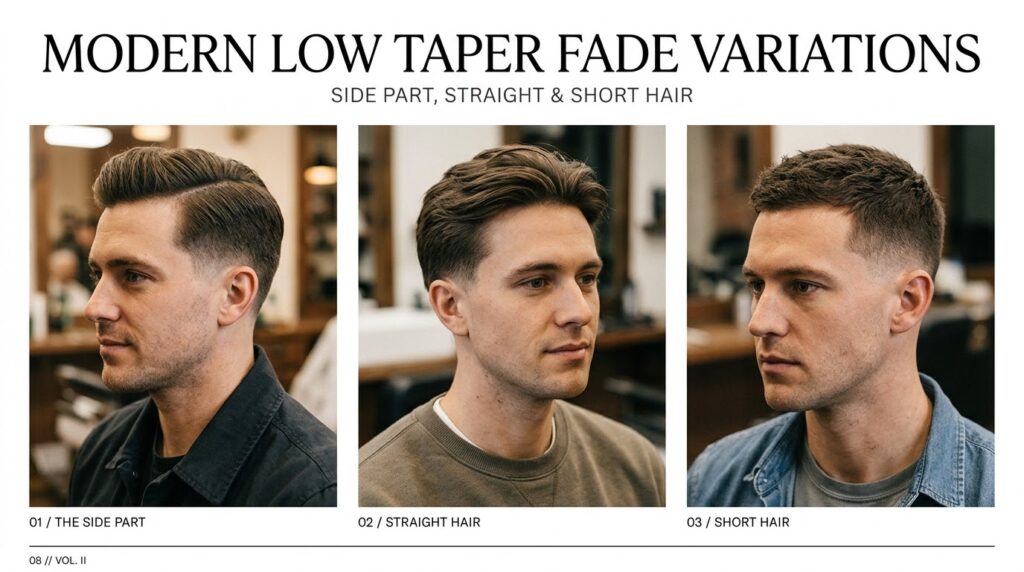
A modern low taper fade mixes clean edges with relaxed texture on top. It avoids stiff, slicked styles. Instead, it looks natural and effortless.
Popular modern pairings include these.
- A textured fringe with a low taper.
- A curly top with a clean fade.
- A messy crop with a sharp neckline.
- A longer top with a soft blend.
For 2026, the trend leans toward natural movement and softer lines. Men want a cut that looks sharp but needs little effort. The low taper fits that need well.
Mid taper fade
A mid taper fade starts higher than a low one, around the temple. It gives more contrast and a bolder look. It is a good middle ground between low and high fades.
This cut suits thick hair well. It removes more bulk from the sides. It also makes the top stand out. For thin hair, it can work if the sides are still dense.
| Feature | Low taper fade | Mid taper fade |
| Start point | Near ear and nape | Around temple |
| Contrast | Soft | Medium |
| Best for | Thin and fine hair | Thick hair |
| Look | Classic and subtle | Modern and sharp |
If you cannot decide, start with a low taper. You can move up to a mid taper next time.
Low taper fade for thin hair
A low taper fade for thin hair is one of the best choices you can make. It looks neat and keeps hair on the sides. It also leaves the top free for styling.
Follow these simple rules.
- Keep the fade low and the blend soft.
- Leave the top two to four inches long.
- Avoid heavy thinning on the top.
- Use matte products only.
- Visit your barber every three to four weeks.
With these habits, the cut gives the look of fuller hair. It also grows out well, which saves you time and money.
Low taper fade haircuts for thin & thick hair straight
Straight hair, thin or thick, can look excellent with a low taper fade. The key is shape and texture. Straight hair needs structure so it does not look flat.
For thin straight hair, add light texture and some lift at the roots. For thick straight hair, remove weight and use a firm product. Both types benefit from a clean neckline.
| Hair type | Top length | Style | Product |
| Thin straight | 2 to 3 inches | Textured crop | Matte clay |
| Thick straight | 3 to 4 inches | Quiff or side part | Pomade |
Blow drying helps straight hair hold shape. Use a comb or brush to set the direction while drying.
Low taper fade haircuts for thin & thick hair male
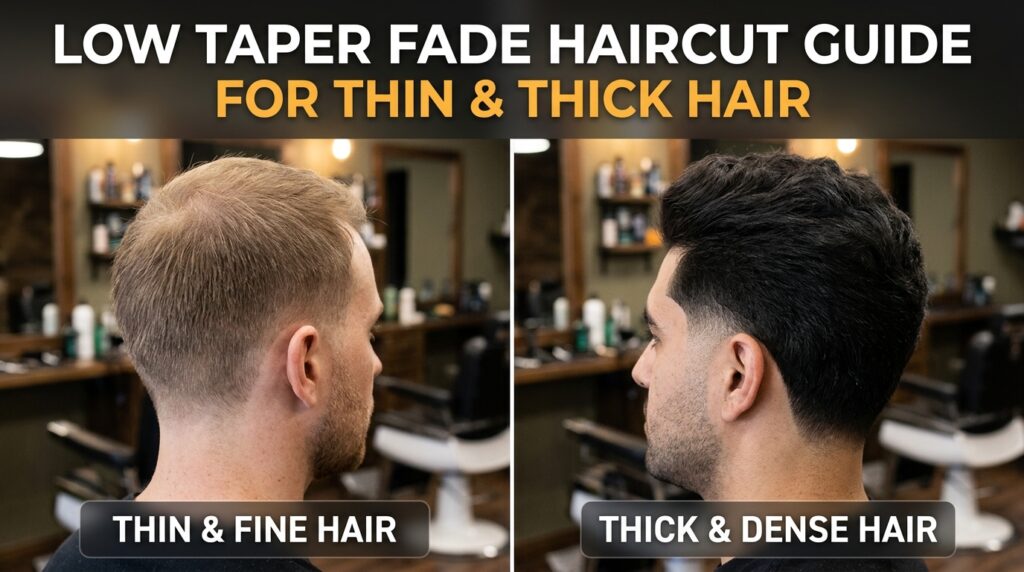
For men, a low taper fade is a safe and stylish choice. It suits students, office workers, and anyone who wants a clean look. It also works for many ages.
Thin hair men should keep the sides soft and the top textured. Thick hair men should ask for bulk removal and a smooth blend. Both should keep a regular trim schedule.
Here is a quick summary for men.
- Thin hair: Soft fade, light texture, matte product.
- Thick hair: Controlled sides, thinned top, strong hold product.
- Receding hairline: Forward fringe or textured crop.
- Curly hair: Taper with a defined curly top.
Talk clearly to your barber and bring photos. A good communication habit gives you a good haircut every time.
Frequently Asked Questions
What is a low taper fade haircut?
A low taper fade is a short cut where the hair blends from longer on top to shorter near the ears and neckline. The change starts low on the head.
Is a low taper fade good for thin hair?
Yes. A soft low taper keeps more hair on the sides and makes thin hair look fuller. Avoid skin fades and heavy thinning on top.
Is a low taper fade good for thick hair?
Yes. It controls bulk on the sides and keeps the shape neat. Ask your barber to remove weight around the ears and blend smoothly.
How often should I get a low taper fade touch-up?
Most people need a touch-up every two to four weeks. Visit every two weeks for a very sharp look.
What is the difference between a low taper and a low fade?
A low taper leaves some length at the bottom for a softer look. A low fade usually blends down to very short hair or skin.
How do I ask my barber for a low taper fade?
Say the fade height, the guard number, and the top length. Bring a reference photo and mention if you want no skin showing.
Which is better for thin hair, a low taper or a mid taper?
A low taper is usually better. It keeps more side hair and creates less contrast, which helps thin hair look fuller.
Final Thoughts
A low taper fade is a flexible haircut that suits both thin and thick hair. For thin hair, keep the fade soft and low, and add light texture on top. For thick hair, focus on bulk control, a smooth blend, and a clean neckline. The right small changes make the same cut look very different.
Choose a top style that fits your hair type and use only the products it needs. Keep a steady trim schedule so the blend stays fresh. If your hair is thinning fast or falling out in patches, speak to a doctor early. With the right plan, your low taper will look sharp all year in 2026.

Ronan Mercer is a measurement focused content writer and researcher at Only Faxhion. He creates clear, practical articles about units, sizes, dimensions, conversions, and measurement concepts, helping readers understand everyday measurement topics through well researched and easy to follow explanations.